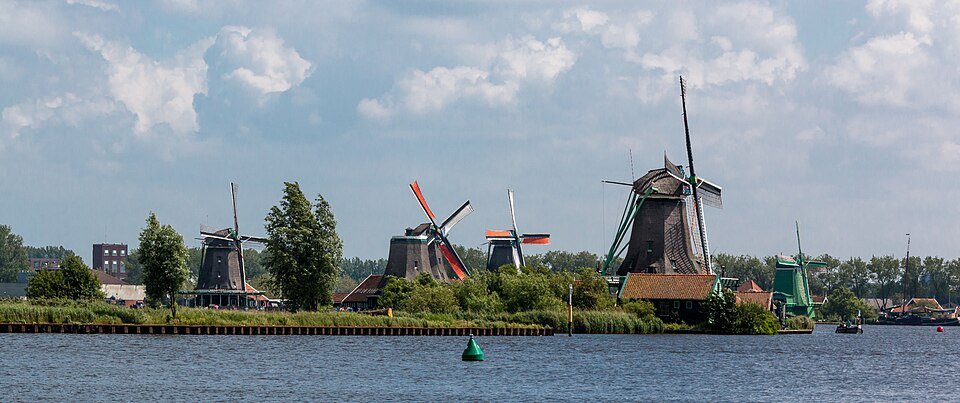
Zaanse Schans: a rescued neighbourhood behind the postcard image
The green wooden façades look like a seventeenth-century village. Most of the buildings have stood here only since the 1960s.
The idea emerged after the war. Post-war development threatened traditional Zaan-region timber architecture: stepped timber walls, decorative gable finials and overhanging structures. Rather than reconstructing everything, historic houses were moved to a strip of land along a dyke near Zaandam. The first windmill arrived as early as 1955, the first house in 1960; from 1961 onwards, heavy transporters regularly brought buildings to the site. Planning documents are straightforward about it: this neighbourhood did not grow here over centuries. It is an assembly of restored original buildings, later supplemented with museums and hospitality venues.
What is authentic is the type. The sawmill produced planks on an industrial scale. The Zaan region became a timber port and a landscape of windmills. Some windmills at the Schans still stand on their original sites; others were moved here. The Schans deliberately does not call itself a conventional open-air museum: people live here and mills continue to operate. The distinction between relocated buildings and later additions is part of the neighbourhood's story.
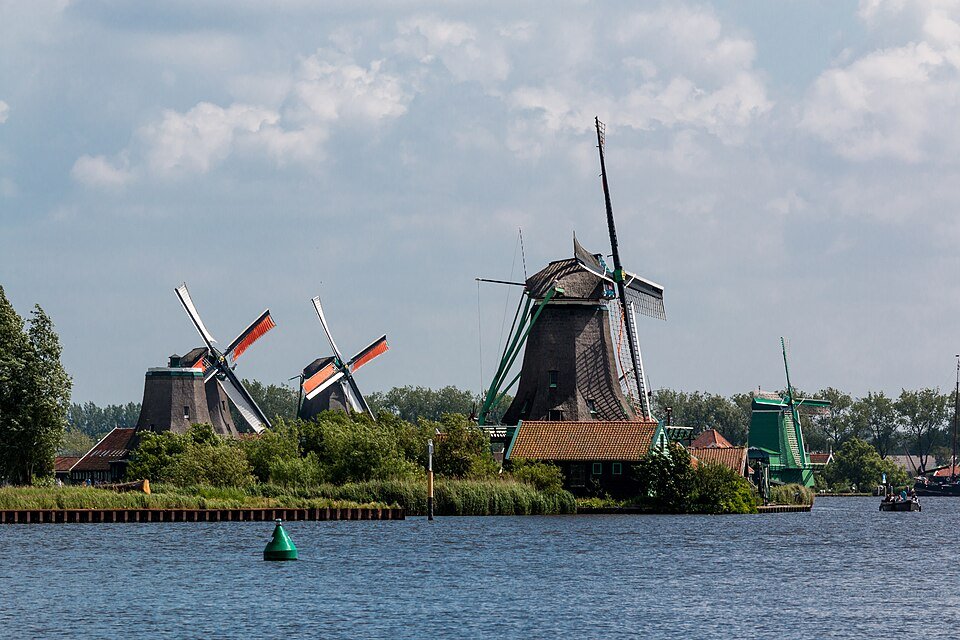
The postcard compresses all of this into a single waterfront. Anyone who merely counts the windmills misses why the houses are here: they would have been demolished elsewhere. Tourism pays for maintenance while at the same time placing pressure on the ‘living village’.
Look at a façade and ask whether it is relocated historic timber or a reconstructed copy. That distinction is the real Zaanse Schans.
A fresh perspective
The post-war plan initially reserved space for dozens of buildings and one windmill; today's Schans grew beyond that plan.
Compare a relocated house with a windmill that still stands on its original site.