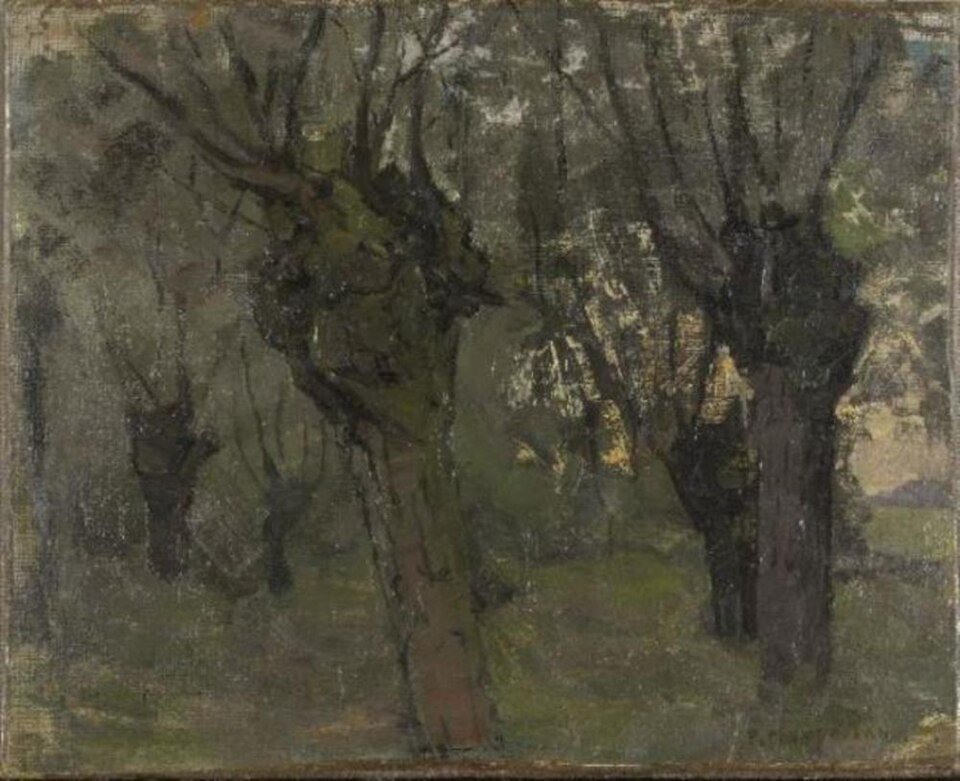
Pollard willows: trees you keep small
Along ditches in river-clay landscapes stand willows with a thick knob and a crown of twigs. That knob is not a disease. It is a pollard head.
A pollard willow is a white willow or crack willow cut back at about head height. Long shoots grow from the stump. Every few years, these are harvested for utility wood, fascines or firewood. If you neglect this, the heavy branches can eventually tear out. Pollarding is therefore maintenance, not mutilation. The landscapes of floodplains, peat meadows and low-lying clay basins are full of them: a row of willows marks a field boundary, breaks the wind and helps hold the bank in place.
Willows thrive with wet roots. Their roots strengthen the sides of ditches. Pollarding lets more light reach the grass beside them. Old pollard heads become hollow and provide shelter for owls or bats. A row that is no longer pollarded gradually loses its compact, recognisable pollard shape. Volunteer teams now do work that farmers no longer routinely undertake themselves.

Recognise the cycle: short stubs after pruning, long shoots after a few summers. Both belong to the same tree.
Dutch river landscapes are partly shaped by this rhythm. The pollard head is a calendar written in wood.
A fresh perspective
The thick knob is built up by years of repeated regrowth from the same height.
Look at the length of the shoots: short means recently pollarded, long means it is due for cutting.