Oil on Zeeland beaches: what heavy fuel oil is and how the coast gets clean again
Oil washed ashore from Westkapelle to Vrouwenpolder, on Noord-Beveland and in Zeelandic Flanders. What kind of oil it is, who cleans the beach, and how discharges at sea are tracked down.
Hollandmagazine editorial team ·
On Wednesday 23 September 2026, the province of Zeeland warned of oil on several beaches. Oil had already been found earlier along the Walcheren coast, from Westkapelle up to and including Vrouwenpolder. Inspections by the province showed the same day that there were also small amounts of oil on Banjaard Badstrand on Noord-Beveland and near the Verdronken Zwarte Polder in Zeelandic Flanders. The first reports came from Westkapelle the Saturday before.
It is partly heavy fuel oil, which lies mainly among washed-up seaweed. According to the province, it is not yet known where the oil came from.
The province’s advice is simple: do not touch the oil and do not clean it up yourself. Keep children and pets away, including from seaweed with oil in it, and do not swim where oil or oil residues are visible. If you get oil on your skin, remove it as quickly as possible and then wash the skin with soap and water.
What heavy fuel oil is
Fuel oil comes from refining crude oil. There are light and heavy types; diesel counts as a light fuel oil. Heavy fuel oil is what remains once lighter fuels such as petrol and diesel have been extracted. It is thick and syrupy, has to be heated to be able to flow, and is used by seagoing ships as fuel for their engines.
How long oil stays in the sea depends on the type. In its explanation of oil spills, the international organisation ITOPF classifies oil according to how long it remains in the sea. Petrol, light diesel and kerosene evaporate quickly and rarely require clean-up work. Fuel oil belongs to the so-called persistent oils: it breaks down slowly and usually has to be cleaned up. Such oil can mix with water to form an emulsion and then remain at sea or on the coast for a long time.
Rijkswaterstaat makes the same distinction: a thin oil that evaporates quickly behaves differently from a heavier oil that barely changes. Once at sea, oil changes under the influence of sun, wind and waves, and the current carries the slick along.
So a beach that has been cleaned is not necessarily finished. Even a beach that is already clean can get oil again the next day: wind, currents and tides bring in new residues, the province warns.
Who cleans the beach

On Walcheren, Stichting Strandexploitatie Veere and Rijkswaterstaat are cleaning up the oil, the province reports. They check the beaches themselves, so you do not need to report individual oil patches. The province is mainly keeping an eye on the official bathing water sites. If there is reason to do so, it will issue new information or swimming advice; the current status can be found on zwemwater.nl.
As manager of the North Sea, Rijkswaterstaat is responsible for limiting the consequences and cleaning up leaked oil. To do this, it can deploy absorbent material, oil booms, skimmers and sweeping systems. According to Rijkswaterstaat, whoever causes the oil is responsible for it. If the polluter is unknown, Rijkswaterstaat takes over, and the bill is later sent to the polluter after all.
How a discharge at sea is tracked down
At sea, the detective work begins in space. The European Maritime Safety Agency EMSA detects oil pollution using satellites, the Coastguard reports. If the images show a disturbance of the water surface, the Coastguard receives a notification. Such a disturbance can also be caused by the weather. That is why the Coastguard aircraft goes to take a look on site. Rijkswaterstaat then assesses how serious the pollution is and tries to trace the polluter for prosecution.
Discharging oil has long been prohibited in the North Sea. According to Ecomare and the Flanders Marine Institute, every form of oil discharge there has been banned since 1999. Under the international MARPOL convention, the North Sea counts as a special area. Ships must hand in their oil residues in port. Because that costs money, illegal discharges still take place, according to both institutions.
An overview by Ecomare and the Flanders Marine Institute states that the number of observed oil discharges in the Dutch part of the North Sea fell from more than 600 a year in the 1990s to about 300 a year. In a 2022 video by Rijkswaterstaat, a mission commander on board the Coastguard aircraft describes what that difference looks like from the air. Ten to fifteen years ago he would still see eight to twelve oil slicks on a four-hour flight, he says, and nowadays no longer.
Whether the source of this oil will be found cannot be said. On 23 September, the province was not yet able to report anything about it.
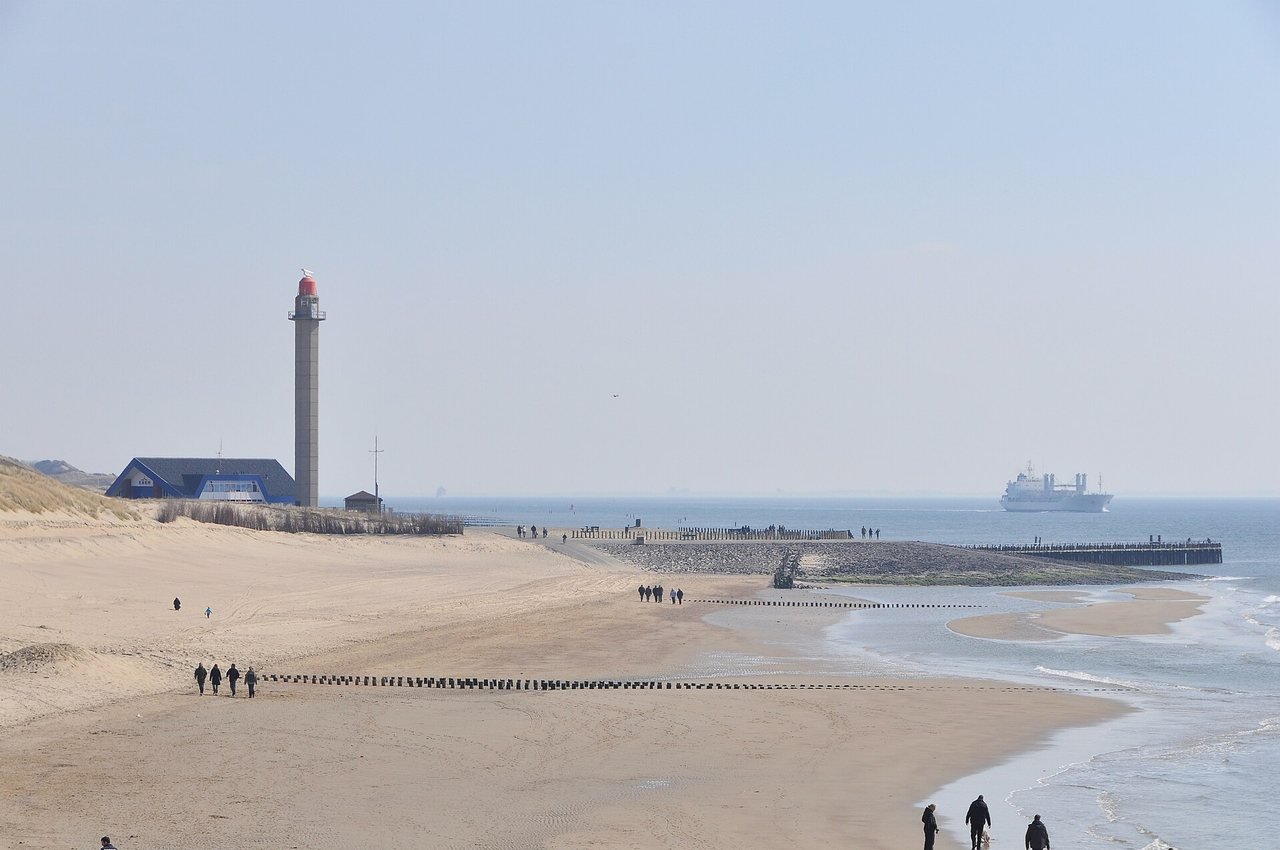
Photo: The beach at Westkapelle on a clear day in April 2013, with a lighthouse at the foot of the dunes on the left and a passing cargo ship at sea. Walkers stroll along the waterline. Marc Ryckaert / Wikimedia Commons (CC BY 4.0)