Skipper Job charged his deckhands rent for the air beneath his sails. On windless days they paid half. Job therefore considered himself a reasonable employer.
He sailed out of Westerschouwen and had a nose for profit. Whenever something strange turned up in his net, he never asked what it was. He asked what it would fetch.
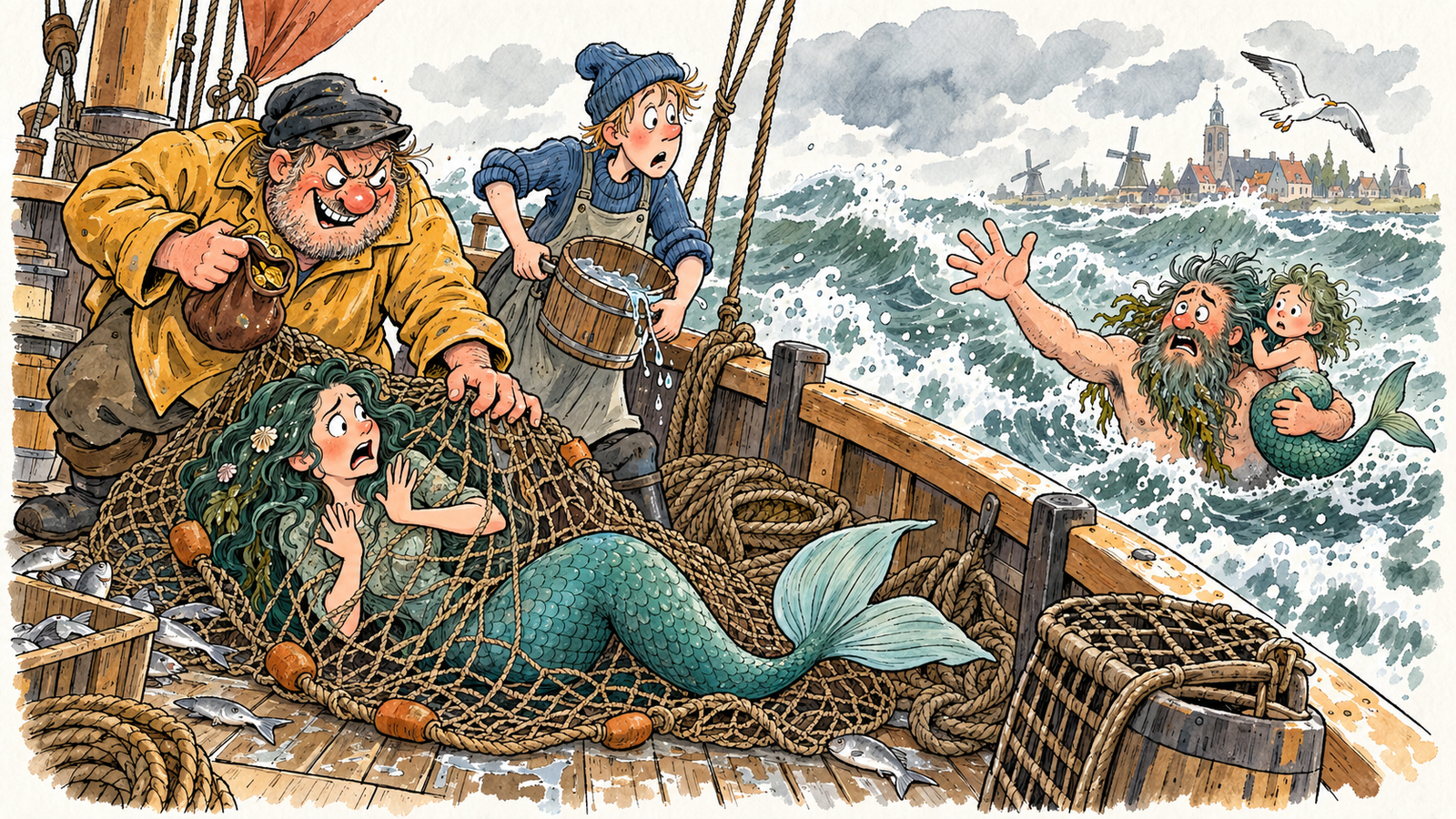
That morning there was a woman standing among the fish.
Not entirely. Her shoulders hung in the net, her long tail slapped against the side of the boat. She had her fingers clamped around one of the meshes. With every breath, her gills opened with more difficulty.
“Back,” she said. “Let me go back.”
Job bent down. A mermaid. In his mind he could already feel the weight of a full purse.
“A living wonder,” he said. “People will come for that.”
The youngest deckhand, Willem, had already taken out his knife to cut the net loose. Job knocked it out of his hand.
“Do you know what a net costs?”
Beside the boat a head rose out of the water. A green beard clung to a brown face. In one arm the merman carried a child; with his other hand he grabbed a rope hanging overboard.
The captive woman stretched her fingers out towards them.
“Give her back,” said the merman.
Job began to smile. So there were more of them.
“What have you got to offer?”
The merman looked at his child.
“We have a home.”
“Under water, no doubt.”
Job laughed. His deckhands laughed along, except Willem. A charge for that would be worked out later.
A crowd was waiting in the harbour. Job had the mermaid laid down by the tower. He placed an empty fish basket beside her. Anyone who wanted to come close had to toss a coin into it.
Out at sea, the child called for its mother. On the quay, Job announced that she had a rare singing voice. The price went up.
Willem came with a bucket of water. Job stopped him.
“Not over the coins.”
The deckhand knelt beside the woman and let the water run over her skin. She looked at him for a moment. Then she looked back towards the harbour mouth.
It did not help enough.
By evening her tail no longer moved.
The people went home. Some wanted their money back: they had stood too far at the back. Job promised that the wonder would be on view again the next morning.
When everyone had gone, the merman came closer. He carried the sleeping child high against his shoulder. He asked for nothing any more.
In his free hand lay a tuft of seaweed with sand caught in it.
That was all.
Job had expected a grand gesture. Lightning, perhaps. He took a step back, out of habit, and put his foot on the fish basket.
The merman let the sand slip through his fingers. He spoke of a harbour that would receive no more ships and a tower that would be left standing alone. Then he turned away.
The next morning, Job’s boat ran aground.
He had the harbour dredged. The men shovelled until their hands split open. At night the sand came back, more of it at a time.
For weeks Job waged his war against grains. He bought bigger shovels. He hired more men. For the first time, he paid Willem without deducting anything from his wages.
Willem took the money and left.
The sea withdrew behind the sand. The boats listed. The shops closed, the residents moved away, and a pale dune crept through the empty streets.
Job stayed the longest. At the harbour mouth he held on to his old fish basket, as if someone might still come along to pay at any moment.
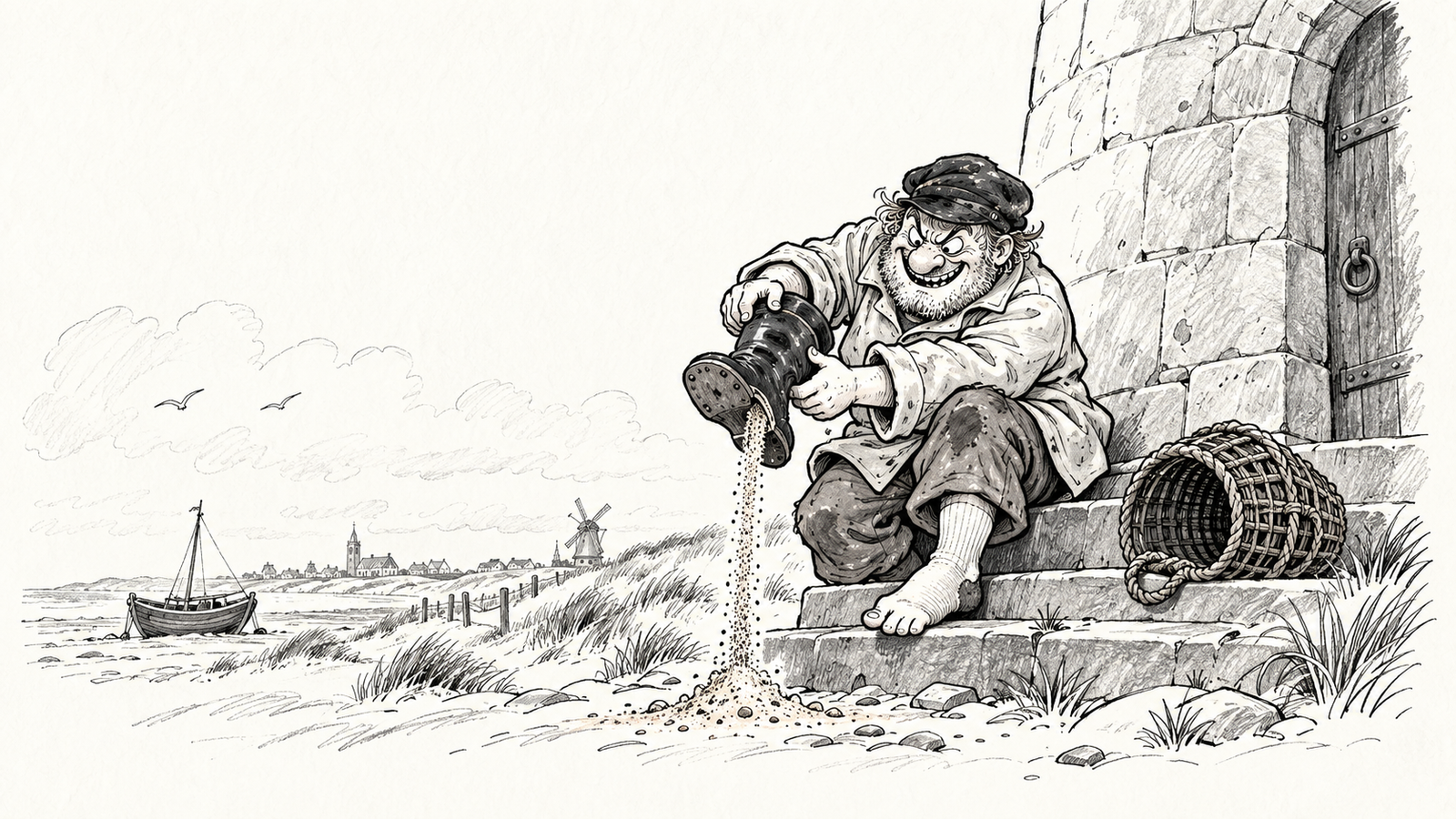
When his house too disappeared under the sand, he walked to the tower. It was still standing.
He sat down on the bottom step and turned his boot upside down.
Sand fell out.
He shook harder.
More came.