The committee began by cancelling the lunch break.
That did not mean the gentlemen would not have lunch. It meant that from now on their lunch counted as meeting time.
There were three gentlemen: Stokkum, Kortum and Bergum. They had to give four Groningen villages a name. This was urgently needed, because a traveller who asked where he was invariably got the answer: here. Anyone who asked for the next village was told: over there. That way, nobody ever arrived anywhere with any certainty.
Stokkum was chairman, because he needed the widest chair. Kortum could see over everyone’s heads and was therefore put in charge of the overview. Bergum had a goose quill. He was the secretary.
“Something distinguished must come out of this,” said Stokkum.
Bergum dipped his quill in the ink.
An hour later there was only a blot on the paper.
“Perhaps food would help,” suggested Kortum.
It was the first proposal on which they agreed immediately.
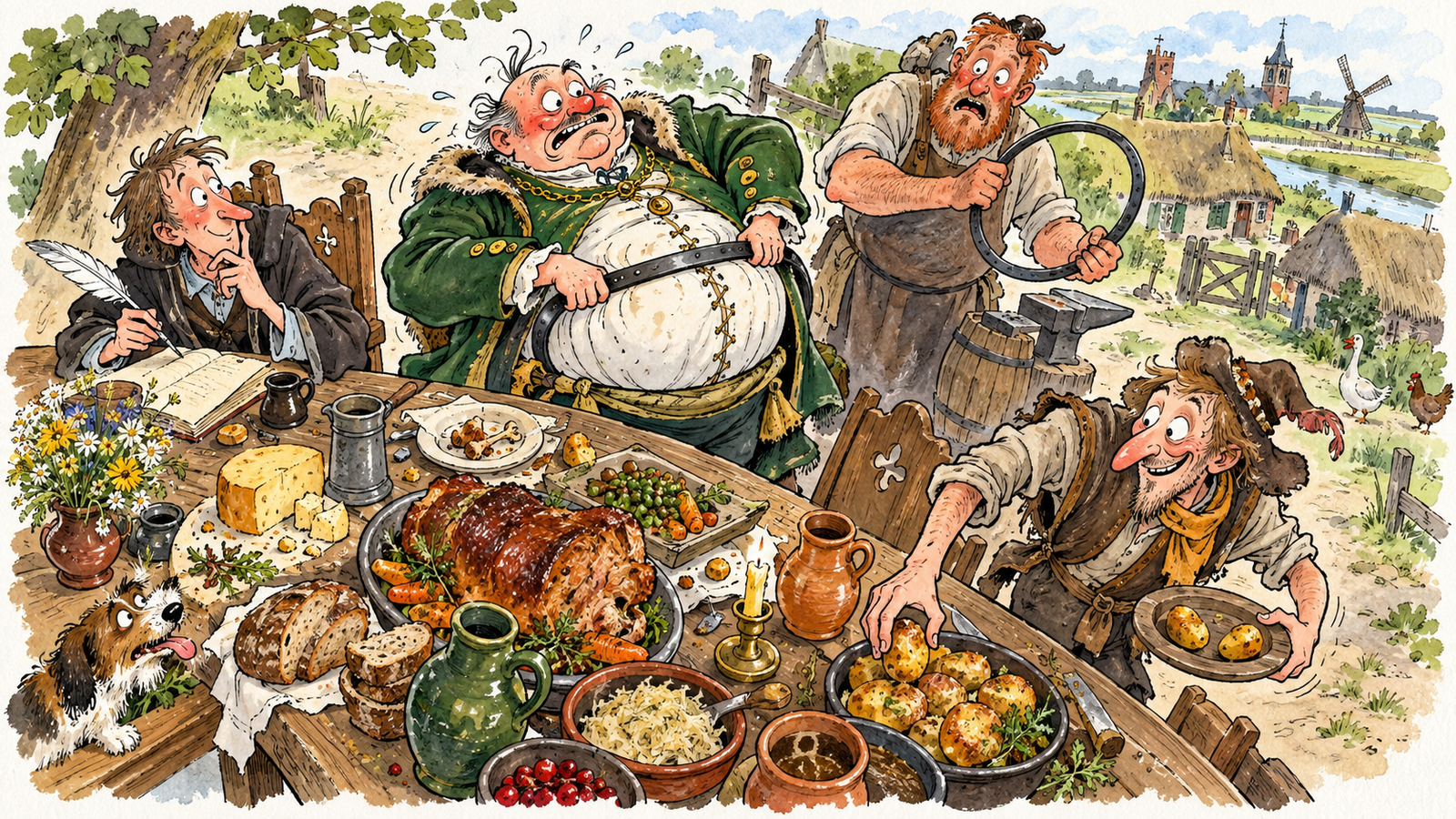
In the first village they were received by an innkeeper who had been hoping for years for a name that would look nice above his door. He brought soup, meat and a dish of potatoes still dripping with butter. Stokkum took a second helping of everything, to check whether the first had been all right.
Kortum had the innkeeper tell him how many houses there were. Bergum asked about the soil. Stokkum wanted to know whether there was any more gravy.
Under the table, something snapped.
The innkeeper bent down, looking for a chair leg that had come loose. It turned out to be a button from Stokkum’s waistcoat. It had shot across the room and landed in the water jug.
“A poor tailor,” said Stokkum.
The blacksmith was fetched. As can only happen in an old mocking tale, he made an iron band to go round the chairman’s belly. Stokkum at once sat a good deal more firmly in his office.
Then the innkeeper came with roast fowl.
“We have to move on,” said Bergum.
“We’re not finished here yet.” Stokkum pulled the dish towards him.
At the last drumstick, the iron began to groan. The blacksmith was already on his feet. Stokkum grabbed the edge of the table.
“One more round it!” he cried. “Eén ’r um!”
Bergum wrote: Eenrum.
At last someone had said something that did not cost money.
At the next stretch of water there was no bridge. Stokkum looked at the far bank and then at the blacksmith, who had come along a little way just to be on the safe side.
Kortum took a long pole.
“Watch closely,” he said.
He pushed off, sailed over the ditch and landed on the grass. That was impressive. All he had to do now was put down his pole.
But for some people, an impressive deed without sufficient admiration is an unfinished deed.
“And back!” called Kortum.
Again he swung through the air. His coat flapped over his head. He landed right next to the spot where he had started.
“There’s that fellow again – daar heb je dat mens alweer,” said Bergum.
He looked at his paper. Then he smiled for the first time that day.
Mensingeweer.
Kortum wanted to jump once more, but Bergum said the village was now full.
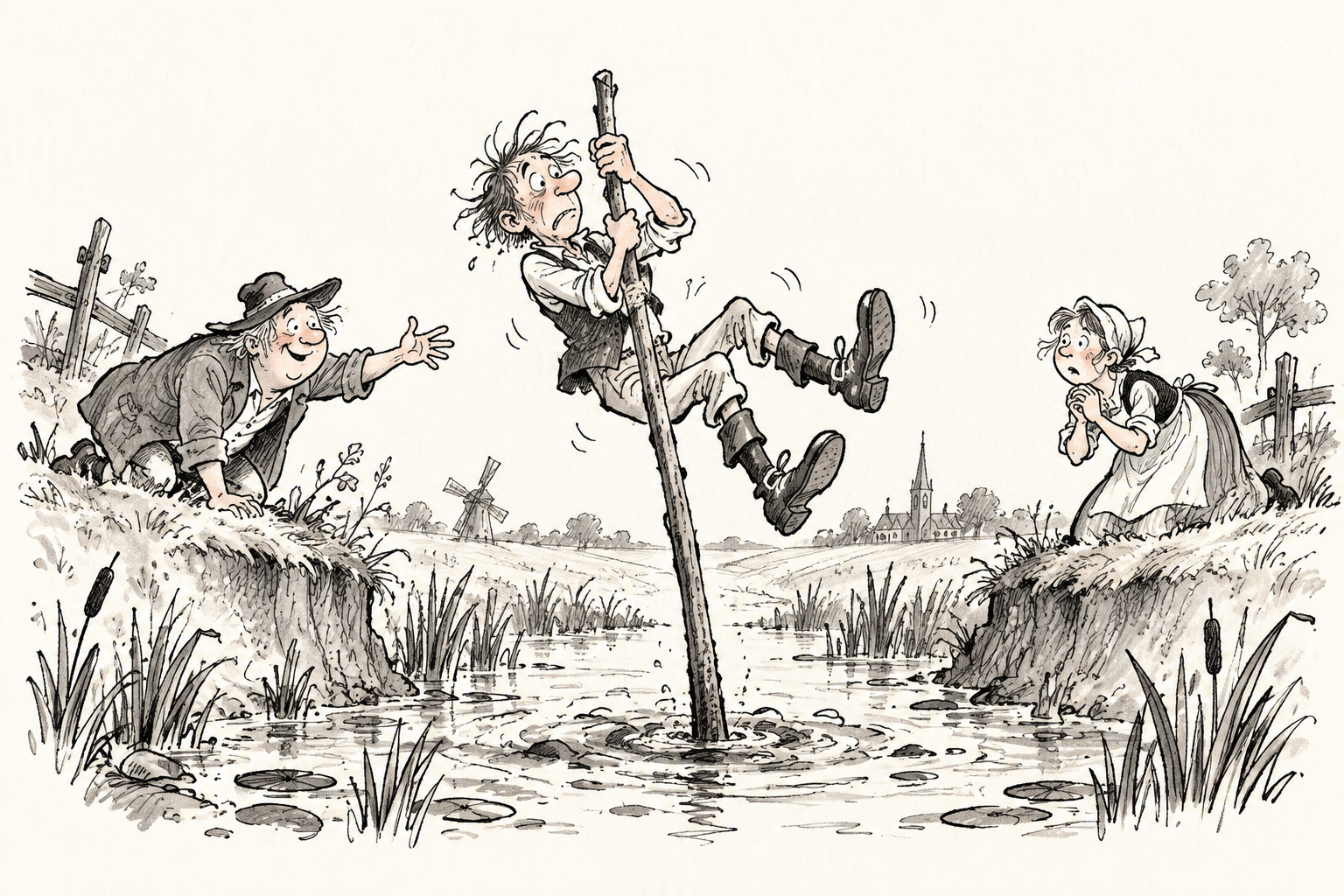
Further on, two villages lay facing each other across the water. This time the secretary took the pole. He wanted to prove that a man with a goose quill could hold something else too.
He jumped.
The pole sank into the mud.
Bergum stayed hanging above the middle of the water.
For a moment it looked quite solemn. Then his left leg began to tremble.
“O, Bergum!” cried Stokkum.
On the far bank, someone came out of a house.
“What is this place called?” he asked.
“O, Bergum!” bellowed Stokkum again.
The man nodded. At last.
Kortum loudly hoped that their friend would make it. “I wish it for him! Ik winsch ’t um!”
From the other side came approving murmurs. Winsum wasn’t a bad idea either.
It took some time before the committee was back on dry land in full. That required two farmers, a rope and the blacksmith. Stokkum had offered to supervise. He did so with extraordinary attentiveness.
Bergum poured water out of his shoes. His paper was soaked through. Only the four names could still be read.
“A fruitful journey,” Stokkum concluded.
The blacksmith held out his hand.
“For the iron.”
The farmers held out their hands too. For the rope. For the trouble. For the lost afternoon.
The three gentlemen looked at one another.
“To which village,” asked Bergum, “should we send the bill?”
For the first time that day, it was a question to which every bystander knew the answer.
“Not to ours.”
Provenance · Freely retold
Based on the Groningen place-name story in Josef Cohen’s Nederlandsche sagen en legenden (Dutch sagas and legends). The puns belong to the mocking tale; they do not explain the actual origin of the place names.
How Eenrum, Mensingeweer, Obergum and Winsum got their names
The dialogue and comic scenes are newly written. AI illustrations depict the tale.