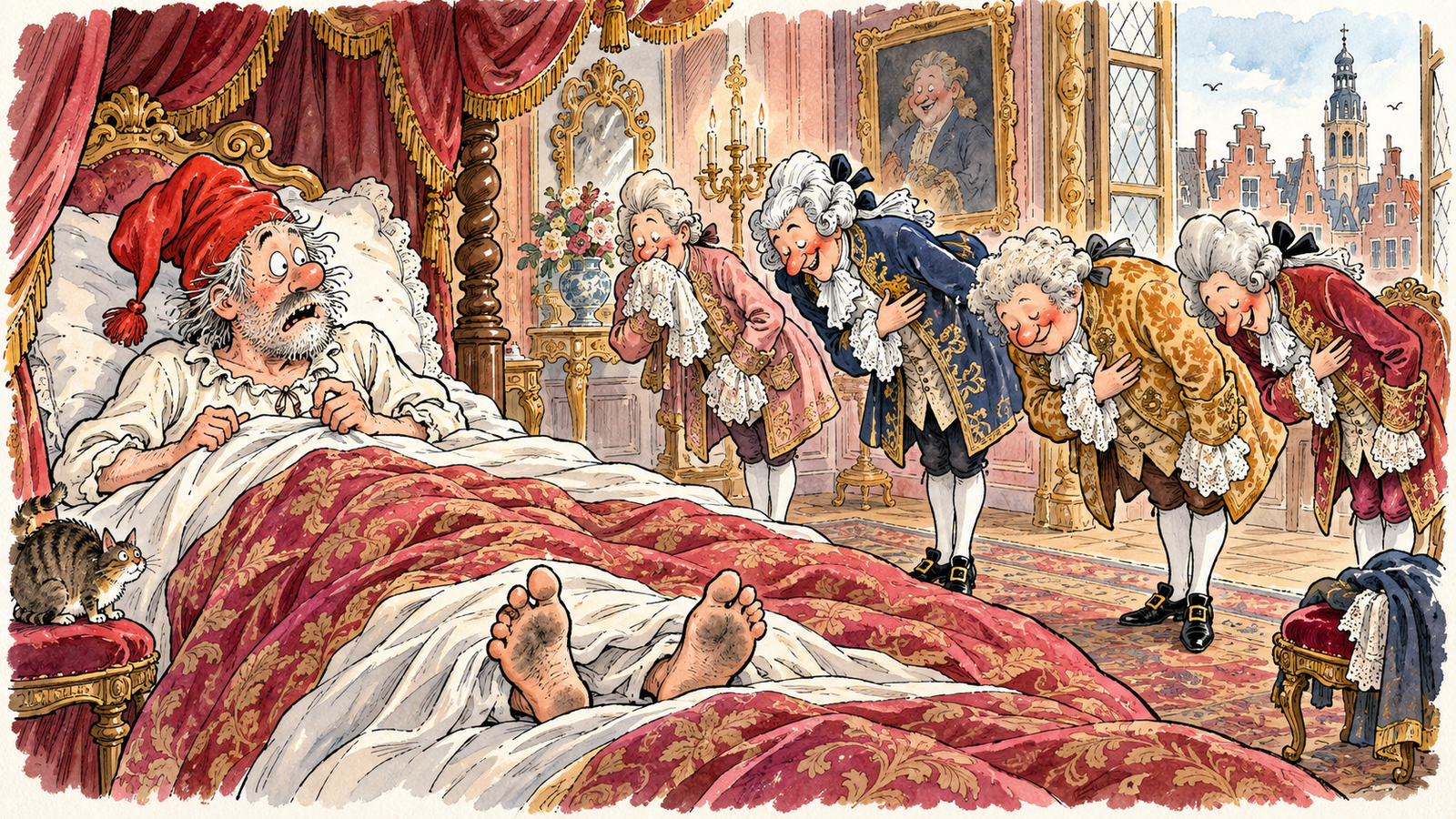
The duke had everything a person could wish for, except a morning on which he was not bored.
That was what he kept courtiers for. They had to make him laugh, and he paid them handsomely as long as the joke was about someone else.
One night, in the Voorhout in The Hague, they found a sleeping cobbler. His name was Willem. He had drunk too much and lay snoring under a tree with the abandon of someone who did not have a single palace to run.
The duke stopped.
“Take him to my bed.”
The courtiers looked at Willem’s shoes.
“In your bed?”
“Without those.”
They carried him off, washed him, put him in a fine nightshirt and set a silk nightcap on his head. Willem snored on. Only when someone touched his feet did he mumble that the soles would easily last another week.
The whole court was ordered to treat him as the duke the following day.
The real duke would watch from behind a curtain.
It struck him as an excellent use of public money.
Willem woke because someone was shaking him very respectfully.
There were people standing round his bed. Too many people, he felt, for a man who did not yet know where his trousers were.
“Your Highness.”
Willem looked behind him.
Nothing. Only a pillow bigger than his entire workbench.
“Your Highness,” the chamberlain repeated.
“I’m Willem.”
The chamberlain smiled pityingly. He had practised that smile for a long time; he usually used it on people who were right.
“You have had a restless dream.”
They brought him breakfast. So much breakfast that Willem thought someone had got the number of guests wrong. A boy held a dish for him.
“Just put it down,” said Willem.
“That is not the custom.”
Willem took a bite. The boy stayed standing.
He took another bite. The boy was still standing there.
Willem looked at the butter, the rolls, the silver and the long row of waiting people. Then he understood what kind of place this was.
“So I’m the boss?”
Behind the curtain, someone gave a stifled snort.
“Without any doubt, Your Highness.”
Willem shifted along.
“Then that boy can sit down.”
The chamberlain went white around the nose. It was an excellently shaped nose that had never before breathed in air so improper.
“A page does not sit at table with the duke.”
“Then maybe I’m Willem after all.”
That was absolutely not allowed. The joke would be spoiled before the duke had had any fun out of it.
A chair was brought.
The boy sat down.
Willem gave him a roll.
The duke behind the curtain was no longer chuckling.
After breakfast they asked what His Highness wished to do. Go hunting? Listen to music? Look at a rare bird?
Willem saw a courtier limping.
“What’s wrong with your foot?”
“Nothing, Your Highness.”
“Then your shoe’s no good.”
That was hard to deny.
Willem had the shoe taken off. He bent the sole, inspected the heel and sniffed.
“Lots of decoration. Little work.”
He asked for tools. The chamberlain said that no cobbling was done in the palace.
Willem looked at him patiently.
The chamberlain had tools fetched.
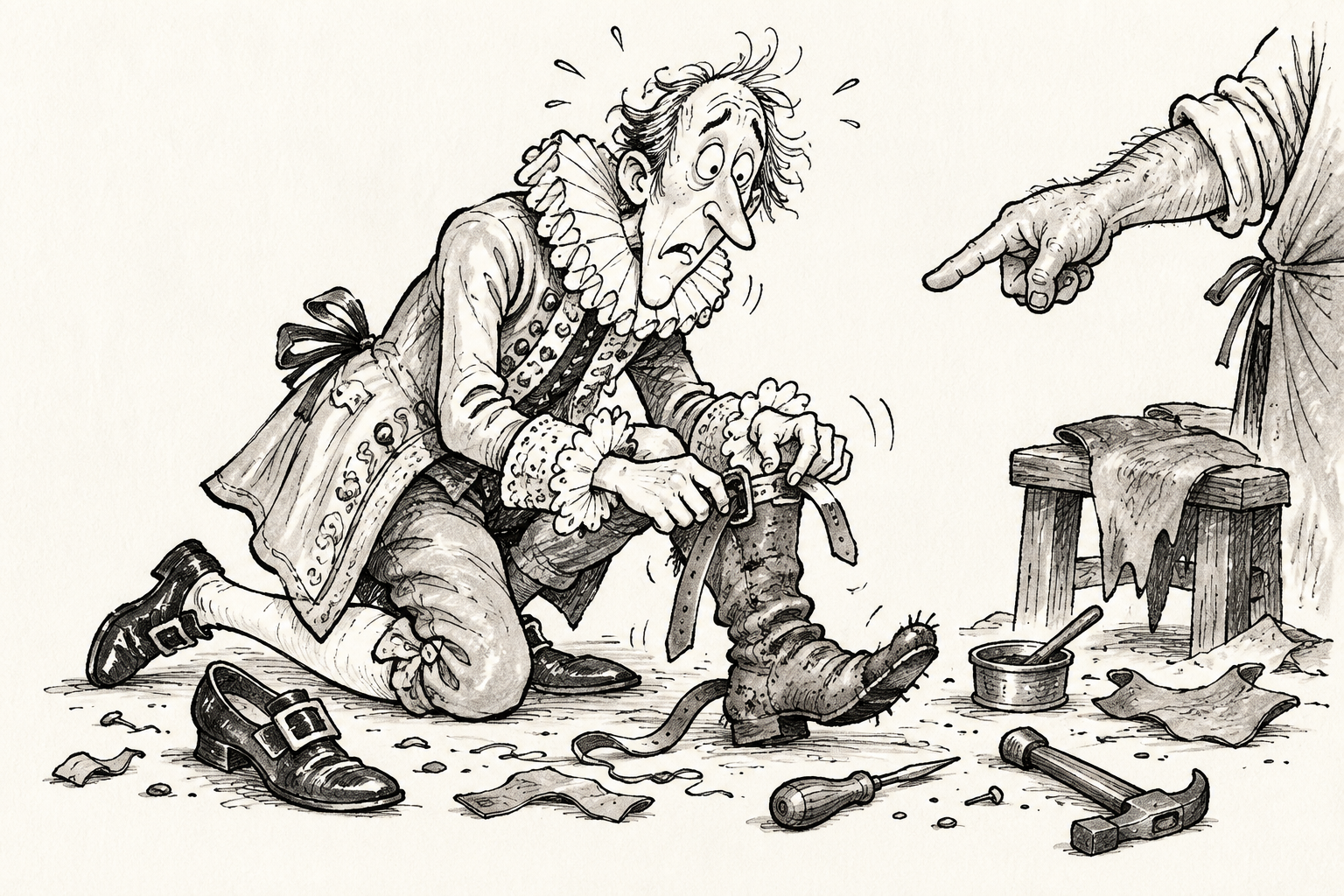
A little later, the man with the lace collar was sitting on the floor holding a boot while Willem explained where the stitch had to go through. The page watched breathlessly. He had finished his roll and was beginning to have hopes for the rest of the day.
The other courtiers stood rooted to the spot. Each of them was thinking up a reason why his own shoes could not possibly be worn out.
Behind the curtain, the duke decided that the afternoon had gone on long enough.
That evening Willem was given a feast. His cup was topped up again and again. When he was once more fast asleep, they dressed him in his old clothes and carried him back to the Voorhout.
He woke under the same tree. His back ached. His feet were cold.
The palace was gone. The page was gone. The chamberlain with the boot was gone.
“A dream,” he mumbled.
He walked home, sat down at his workbench and picked up a shoe.
A few days later, a servant came to bring a pair of boots. Willem recognised them at once. The heel was still loose. Inside was a crooked little stitch, the most unfortunate little stitch he had ever seen.
He held up the boot.
“Who’s been botching this?”
“I couldn’t say,” said the servant.
Willem felt under the rim. There was the little knot he had made the chamberlain tie himself.
He smiled.
On the bill he wrote an amount. Then he added another amount beneath it.
For the lesson.
Provenance · Freely retold
Based on De slaper in het Voorhout (The Sleeper in the Voorhout) in Josef Cohen’s Nederlandsche sagen en legenden. A sleeping poor man is treated as a ruler and later carried back. Willem, the page, the boot lesson and the bill are our own elaborations.
The dialogue and comic scenes are newly written. AI illustrations depict the tale.