The lady of Stavoren dismissed her kitchen maid for licking a spoon.
The spoon was hers. The soup was hers. And whatever the maid had taken off it with her tongue, she would never get back.
“It had to be tasted,” said the girl, rubbing her wet cheeks with her apron.
The lady raised a finger that looked like a peeled asparagus spear.
“Then you owe me money.”
From then on, a slate hung beside the stove with an official price list. A lick cost a doit. Slurping cost two doits. Anyone who closed their eyes while tasting paid double. That was enjoyment, and in this house enjoyment was strictly at your own expense.
The new cook had therefore found an exceptionally ingenious way of checking the soup: he served it straight to the lady.
That was how, one Tuesday, she discovered that the milk was sour.
On Wednesday, that the pepper pot no longer had a lid.
And on Thursday, that a fly could hide perfectly well under a sprig of parsley.
The cook was dismissed. The fly was allowed to stay. At least it had looked after itself.
Incidentally, the lady was not called the Little Woman. Nobody in Stavoren would have dreamed of calling her that, unless he wanted his trading barge put in chains or his warehouse accidentally bricked up to the doorstep.
Her entire existence consisted of counting the things that belonged to her and working out how to stop other people from looking at them. Looking, after all, wore things out.
One rainy morning she summoned her skipper. He had a left knee that creaked like a breaking mast, and he disliked her lace collar, which smelled of vinegar.
“My warehouses are bursting,” she said. “Cloth, wine, stockfish. I have an attic full of goods that would make the cats faint. I am bored.”
“You could give alms.”
She looked at him as if he had suggested she eat her shoes.
“You sail tomorrow morning. Take the biggest ship and bring me the most precious thing there is.”
“And what would that be, exactly?”
“If I knew that, I wouldn’t need to send you, you oaf. Use your brains, insofar as the ship’s biscuit hasn’t rotted them. And if you come back with rubbish, you pay for the voyage.”
The skipper waited until he was outside the gate before he spat in the gutter.
He sailed for months. He looked at carpets woven with gold thread, chests of precious stones and silver dishes in which a man could admire his own important face. But each time he thought of his mistress’s warehouses. Everything lying there had once been something she absolutely had to have.
In Danzig he saw a merchant standing at a baker’s. The man wore a velvet coat and was offering his gold chain for a loaf of bread.
The baker shook his head. His flour was gone. The merchant began to weep without putting his chain away.
The skipper looked at the gold. Then at the empty shelves behind the baker.
He sailed on, to a region where the harvest had been good. There he bought grain. Sack after sack, until the ship’s carpenter urgently asked him to leave some room for the water under the ship as well.
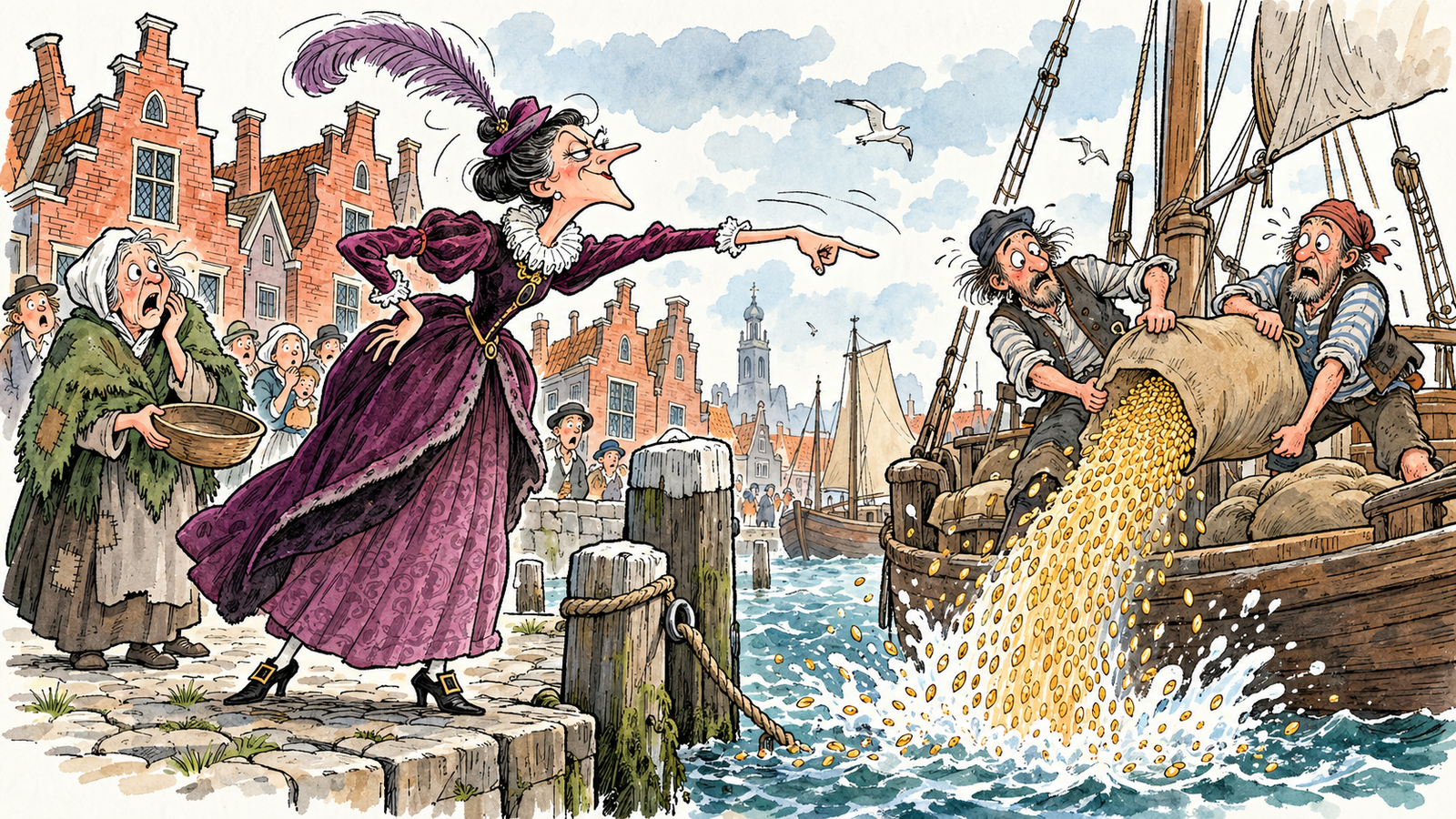
When he sailed into Stavoren, the lady was already standing on the jetty. Her purple dress rustled like dry autumn leaves. She tapped her shoe against a mooring post.
“Well? Pearls? Sapphires? Speak up!”
The skipper slit open a sack and let the grains slide through his calloused fingers.
“Grain, my lady. Those who are hungry give their last gold for it.”
Her lips pressed into a pencil line.
“Grain?”
“The finest I could find.”
“Chicken feed?” Her voice shot up. “Have I let you bob about for months at my expense for a load of chicken feed?”
“The bakers will be glad of it,” said the skipper.
That was the wrong thing to say. She had not sent him off to make the bakers glad.
“Which side did you load it on?”
“Starboard.”
“Then it goes out again on the port side. All of it. Into the water.”
He stood there with the sack in his hands.
“You heard me.”
From among the onlookers, an old woman shuffled forward. She wore a patched shawl and held up a wooden bowl.
“Give it to the people, my lady. There are families who have to share their last crust.”
The lady drew her skirt away from the outstretched bowl.
“Beggars’ advice,” she said. “About the only thing cheaper than grass.”
“Perhaps one day you’ll have to ask for bread yourself.”
The lady slipped off her glove. On her finger was a heavy gold signet ring with a little flower on it. She worked it loose and held it above the water.
“First this comes back. Then you may talk about my poverty.”
She threw it.
Plop.
The water closed over it.
“Unload,” she told the skipper. “Before sunset.”
The sailors slit the sacks open. Their jaws were set. For hours the grain poured over the rail, while on the quay people who could have baked bread with it looked on.
That evening the lady ate pheasant with stewed prunes. She ate with her mouth closed, because chewing with it open wasted breath.
A few weeks later, the cook — number four that month — was cleaning a big fish. His knife tapped against something.
Clink.
He fished a yellow object out of the belly and rubbed it clean on his apron.
The gold ring. With the little flower.
He washed it three times, laid it on a saucer and walked to the great hall.
“Found it, madam. In the fish.”
Her fork stopped halfway to her mouth. Half a prune fell onto her napkin. Her face took on the clammy colour of cold lard.
She reached out her hand, pulled it back and looked at the cook.
He held the saucer a little closer.
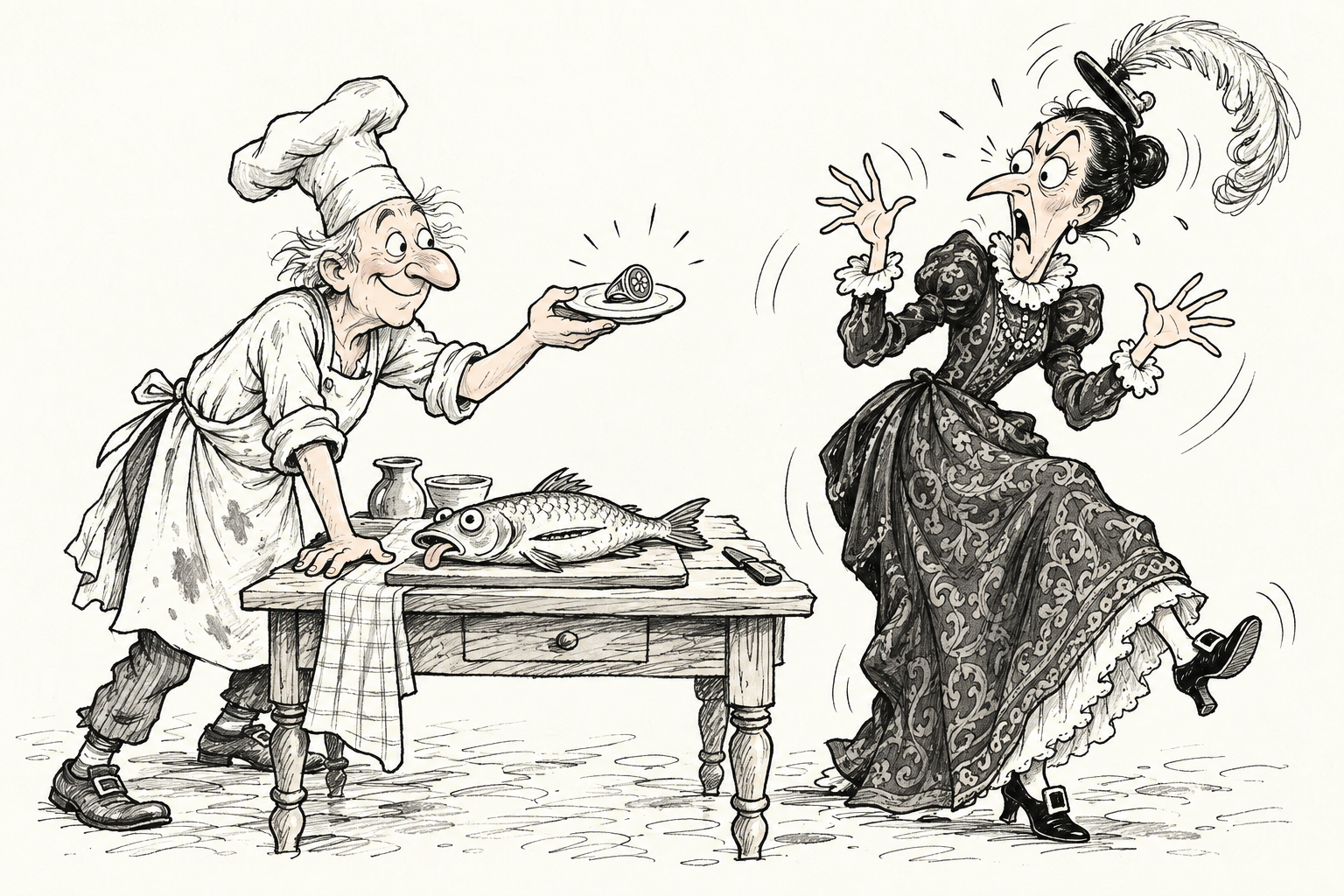
At last she snatched the ring off it. She clenched it in her fist and sent the cook away. She did not touch the pheasant.
The cook ate it in the kitchen. He kept his eyes open.
The next morning a messenger came to tell her that her ships had gone down in a storm.
“How many?” she asked.
He named them. After each name she drew a line on a slate. At the last ship, the chalk broke.
By midday word came that her banker had disappeared with her money. She sent someone to fetch him back. By evening it turned out that this man, too, was still owed wages by her. He did not come back.
That night her warehouses burned.
The lady ran to the quay in her nightclothes. People with buckets stood around the flames. She pushed her way in among them.
“Not on the silk! It leaves stains!”
Then the roof caved in. A cloud of sparks rose above the harbour. Her silk no longer stood any chance of getting wet.
She tried to shout above the fire. Nobody understood her. For the first time in her life, her orders were treated as a completely unimportant noise.
In the legend, the discarded grain came back too, in a way that was of no use to anyone. Where the cargo had been tipped into the sea, a sandbank grew. On it stood stalks that looked like corn, but the ears were empty.
The ships ran aground. The trade disappeared. The warehouses emptied, and weeds sprouted between the stones of the quay. People called the bank the Vrouwenzand, the Lady’s Sand.
The lady did not get a penny for it.
Her furniture was auctioned. Her silver was weighed. During the weighing she watched so closely to make sure the buyer did not pocket a scrap that she did not notice her chair being sold out from under her.
Her house was demolished. People took the bricks away for sheds and pigsties. A farmer came to tell her that her gold door knocker had fetched an excellent price.
She asked how much.
He did not say.
Years later, skippers on the quay saw a bent little woman walking along. She wore a dress made of jute sacks and two odd, broken clogs. Nobody stepped aside for her any more.
When a skipper’s wife gave her a hunk of rye bread, she first held it up to the light suspiciously. She picked off a bit of crust with her fingernail and chewed on it with her last four teeth.
“Too salty,” she muttered. “Baked far too salty. In the old days I wouldn’t have given a penny for it.”
But she ate it.
Down to the last crumb.
Freely retold from Het vrouwtje van Stavoren (The Little Woman of Stavoren) in the Volksverhalenbank. The dialogue and scenes have been worked out for this version. Sources and provenance of the collection.