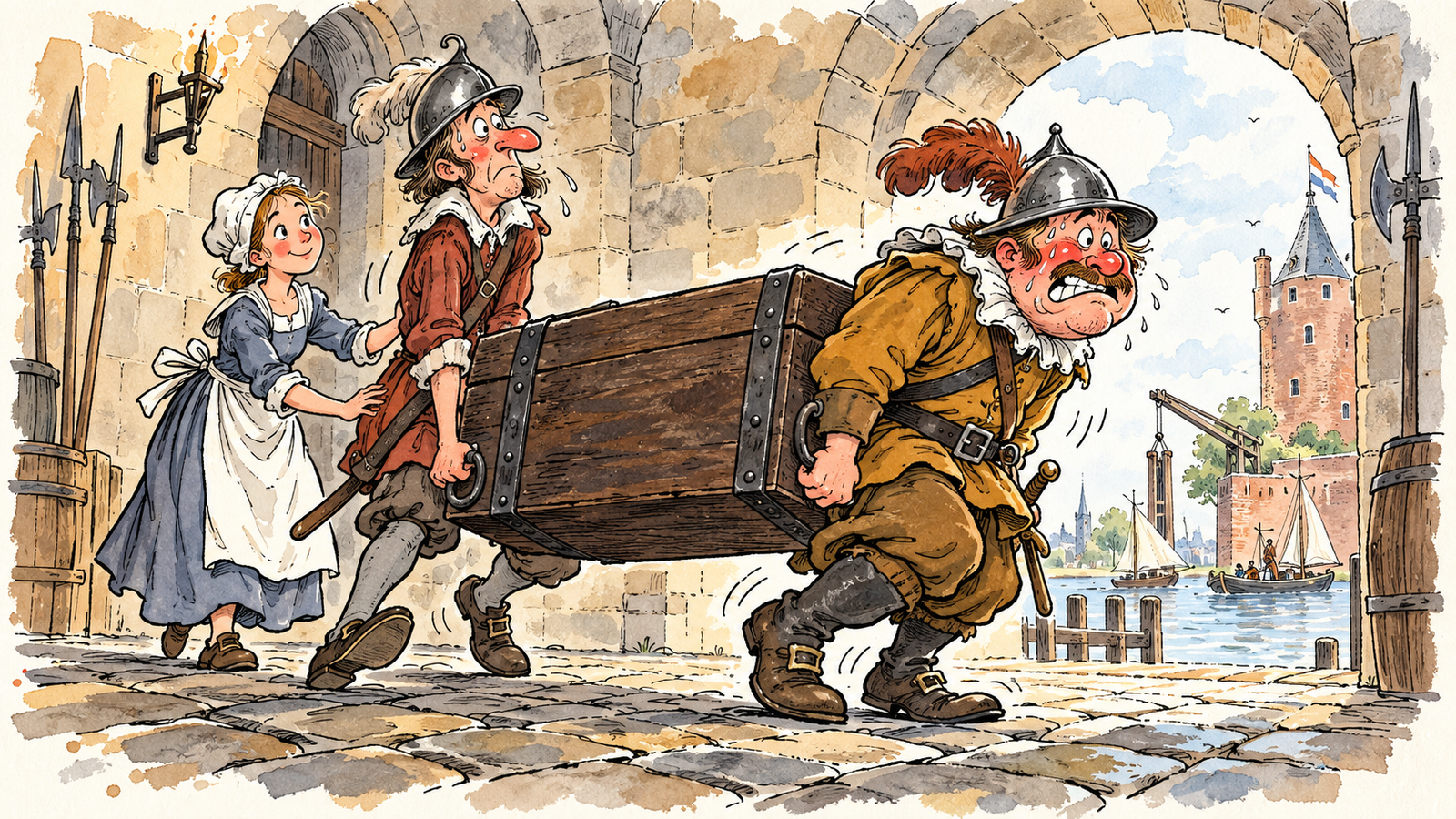
One of the guards at Loevestein had a habit of counting his prisoners just before he went to eat. If he came up one short, he counted again. If he still came up one short, he ate first. Cold porridge was a disaster that could be prevented.
He was a short, broad man with a moustache in which his breakfast stayed for the rest of the day. He had a particular dislike of Hugo de Groot. The man was locked up and yet read more books than a free man. To the guard, that looked like abuse of his sentence.
Hugo was a scholar who had been given life after a quarrel about religion and government. The men who had locked him up considered his thinking dangerous. They did, however, let him have books delivered. Apparently they hoped he might one day read something sensible in them.
The books came in a wooden chest. When Hugo had finished them, they went back in the same chest.
At first, the broad guard stuck his nose between the books at every delivery. He leafed through them so grumpily that you might almost have thought he understood what they said. After a few times, he stopped bothering. A book was a book. A chest was a chest. And the porridge was getting cold.
Hugo’s wife Maria noticed.
Maria noticed plenty of things. That her husband was slowly taking on the colour of the walls. That he took notes even while eating. And that someone who knew so much about the rights of man did precious little with his own legs.
One morning she took the books out of the chest.
“Try lying down in there.”
Hugo looked up from his paper.
“In what?”
“There’s only one empty chest in here, Hugo.”
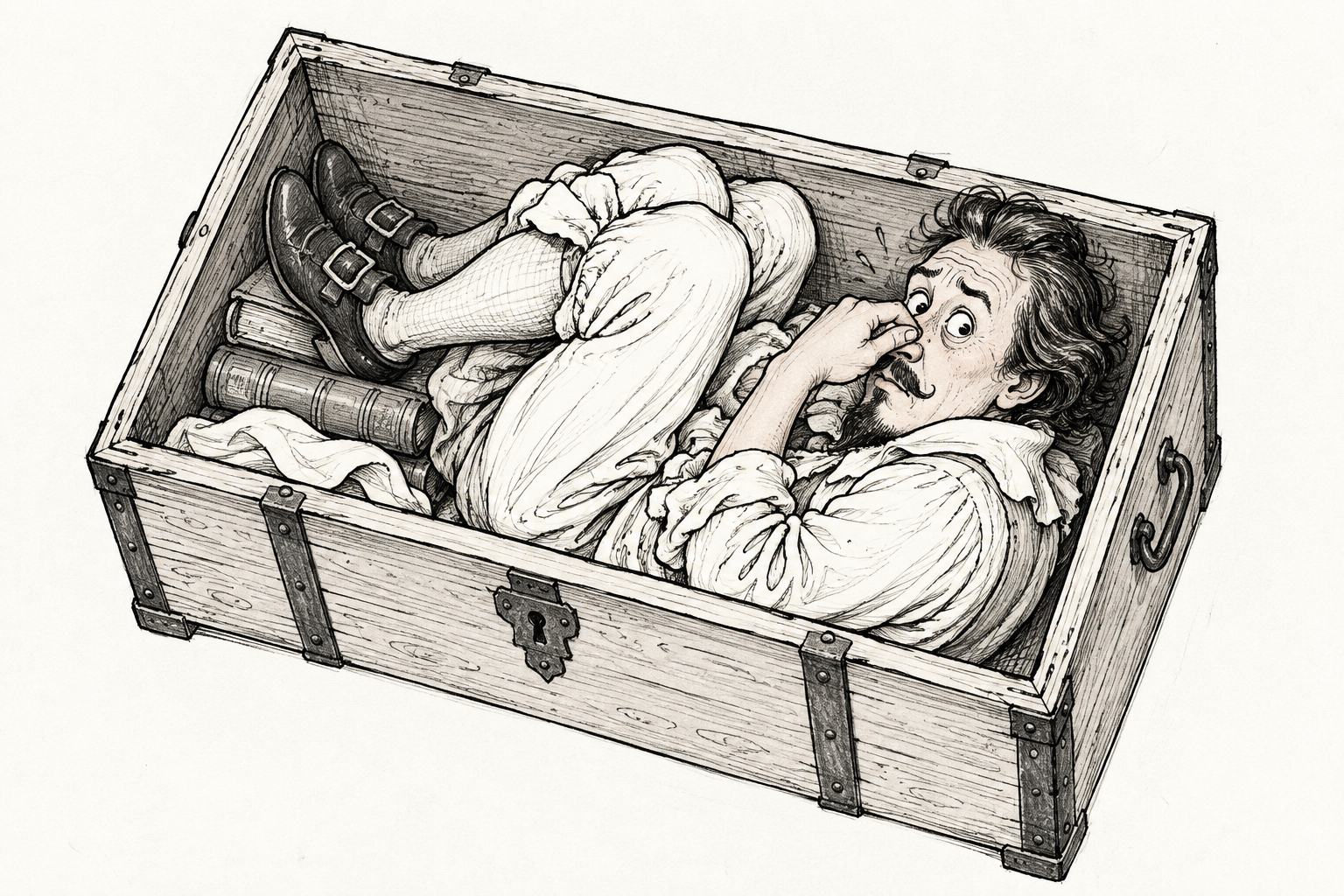
He put one foot over the edge. Then the other. He crouched, turned and wedged a knee under his chin. His right foot went on sticking out, like an objection he had forgotten to withdraw.
Elsje, the maid, gently pushed it back in.
“There. Now the head.”
“My head is already in the chest.”
“Then you’ll have to move it about less.”
Maria lowered the lid. Just before it closed, an index finger rose into the air.
“There are, however, a few objections.”
“They’re coming too,” said Maria.
They practised. First Hugo lay in it briefly, then longer. Maria listened at the door. Elsje kept an eye on the corridor. Hugo discovered that he possessed a part of the body about which he had never written a single learned line: the spot where the rim of a chest digs into your backside.
By now he had enough to say about it to fill a whole book.
On the morning of the departure, Maria put books in his bed and pulled the blankets over them. In the half-light it looked rather learned.
Hugo stood beside the chest in his underclothes. Now that someone could actually be called to carry him away, the plan suddenly seemed remarkably small to him.
“And you?” he asked.
Maria smoothed a crease from his sleeve.
“I’m staying here. Otherwise they’ll start searching.”
He held her hand. For a moment all you could hear was a shoe sole scraping along the corridor. Elsje watched the door.
Then Hugo climbed into the chest.
“No lectures on the way,” Maria said softly.
This time he had no answer.
The lid closed.
The broad guard came with a tall soldier who seemed to consist entirely of knees and elbows. They took hold of the handles and lifted.
The broad one immediately dropped his end again.
Inside the chest, Hugo bit his tongue.
“What have those books been eating?” asked the soldier.
“They’re thick ones,” said Elsje.
The guard wiped his moustache. A bit of porridge came away with it.
“Must be the scholar himself in there.”
Maria felt her nails in her palms. Elsje bent down to check the fastening. There was nothing to check, but her face needed to be somewhere else for a moment.
The guard began to laugh.
His mate laughed along. They thought it an excellent joke. So excellent that neither of them bothered to lift the lid any more.
They hoisted the chest up again.
On the stairs, Hugo made the discovery that his escape could fail in two ways. They could catch him. They could also drop him.
The bearers were working hard on the second possibility.
“Your end higher,” panted the broad one.
“Then yours has to go lower.”
“I’m already lower!”
That was true. His face hung just above the wood. Hugo could hear him snorting through the side.
Then his nose began to tickle.
At first it was a modest tickle. The kind of tickle that drops by to see whether anything is going on. Hugo raised his upper lip. The tickle took that as an invitation and crept further in.
He tried to reach his nose. His hand was under his knee. To free it, his knee had to go up. His chin was already lying there.
A learned man in a book chest is mainly a collection of parts that get in each other’s way.
The chest bumped against the wall. His hand shot free. He grabbed his nose and pinched.
Outside, the tall soldier said: “Did you hear something?”
The broad one stopped.
Elsje saw the knuckles around the handle turn white. Under the moustache, a mouth blew out air. One more moment and he would put the chest down.
“One of the books has come loose,” she said. “Shall I fetch some cloths from upstairs? Then you can take it back up.”
The broad one looked up the stairs he had just toiled down.
He looked down the stairs.
“Keep going,” he said.
Inside the chest, the most dangerous scholar in the castle pinched his nose shut as if his entire learning threatened to spray out of it.
At the water they set the chest down. Elsje went on board with it. She kept her hands as still as she could in her lap and watched the castle slowly grow smaller.
Hugo could see nothing. That was the worst part. He could not check whether they were sailing, whether anyone was looking at him, whether Maria was safe. He could only wait. And listen to the water, which seemed to be everywhere at once.
When the boat arrived in Gorinchem, the chest had to be carried again. One more street. One more threshold. A final thump that, for a moment, turned Hugo’s teeth into a single tooth.
In the house of the Daetselaar family, the bolts went across the door.
Elsje tapped on the lid.
“We’re here.”
The chest stayed silent.
She opened it. There lay Hugo, wide-eyed, his hand still clamped around his nose.
“You’re allowed now,” she said.
He sneezed.
It was no modest sneeze. It was a sneeze with a backlog to clear. Elsje recoiled. A thread flew off his shirt. From another room, someone called out to ask whether the door had slammed.
Then the scholar had to be unfolded. First a foot, then an elbow, then something that turned out to be a second foot. When he was finally standing upright, Elsje explained to him that he had to disguise himself as a bricklayer.
“I am not a bricklayer.”
“You weren’t a book either.”
There was no arguing with that.
Back at Loevestein, that evening the broad guard came up one prisoner short.
He counted again.
He looked under the bed. Behind the door. Finally he threw back the covers. There lay books. He poked at them, as if Hugo might have flattened himself between two pages.
Then he ran to his mate.
“He’s gone.”
The tall soldier looked at his hands.
The broad one looked at his.
The next morning, the entire watch had to hear how the escape could have happened. The broad guard told them about the chest. About the weight. About the stairs.
“And you noticed nothing suspicious?”
The guard straightened his back. His moustache quivered with wounded pride.
“On the contrary,” he said. “I even said so.”
A free, comic retelling of Hugo de Groot’s escape from Loevestein. The guards, the dialogue and the sneezing scene are invented. The main historical outline is described by Loevestein Castle and in Wagenaar’s historical work at DBNL. Sources and provenance of the collection.