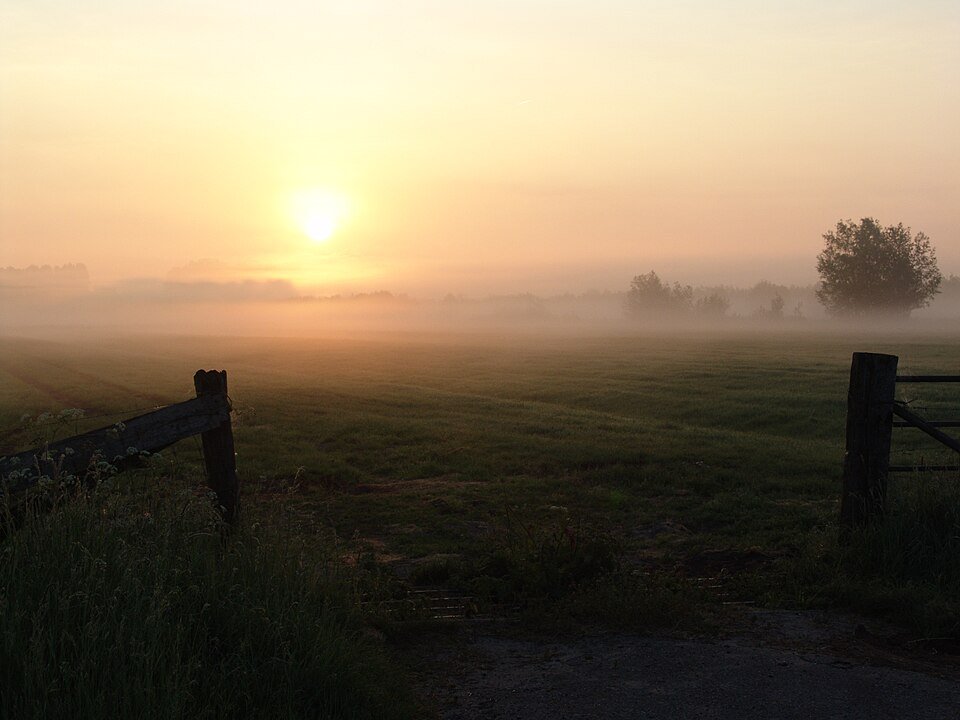
Fog over meadows: why the ground creates a blanket at night
After a clear night, a white layer lies over the grass while the city is still visible. It is not a cloud that has settled on the ground. It is the meadow giving off its heat.
Fog is not smoke and it is not low-lying rain. It consists of tiny water droplets suspended near the ground. We speak of fog when visibility falls below one thousand metres; below that come dense and very dense fog. The process behind it is condensation: at a given temperature, air can hold only a limited amount of water vapour. When that air cools to the dew point, the vapour condenses into suspended droplets. What you see, then, is saturated air, not haze from a chimney.
Over meadows, this is usually radiation fog. Under a clear sky, the ground radiates more heat at night than it receives. Grass and damp soil cool quickly; the air immediately above them follows. In the city, stone and residual heat slow that cooling. In open countryside, they do not. The conditions are: little cloud, enough moisture, and wind that is neither too strong nor too weak. If there is no wind, the moisture settles as dew. Gentle mixing keeps the droplets suspended in the air. Too much wind mixes the cold air near the ground with drier air above; the layer disappears or turns into low cloud.
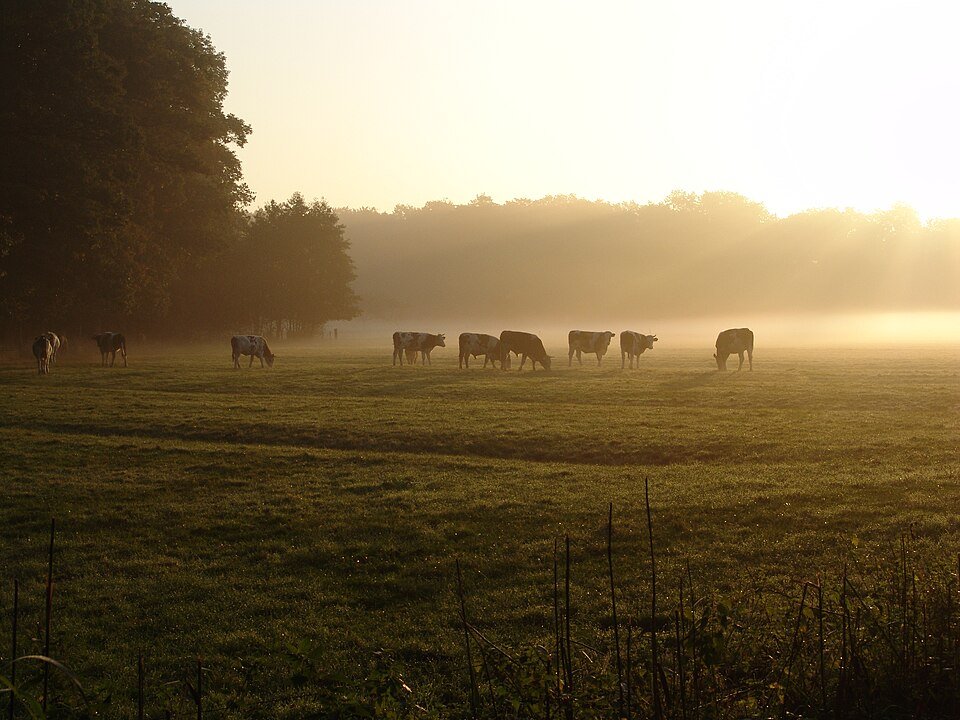
Cold air is heavier. It sinks from a sloping meadow towards the ditch. There is extra moisture there. This is how a bank of fog can grow that looks like a sea from the dyke, while two meadows farther on the view is still clear. That is why meadow fog can be treacherous for traffic: it lies low, it is local, and it follows the terrain.
During the winter half of the year, the nights are long. In the morning, the sun has less power to warm the ground from below. That is why meadow fog lingers longer in autumn than in June. Advection fog is a different story: warm, moist air flowing over a cold surface, for example from the sea. The white blanket over a meadow after a starry night is almost always caused by radiation.
What you see from a small bridge is local physics. The field has lost its heat. The asphalt beside it often has not. Look at the gap above the road: there, the stone has slowed the cooling.
A fresh perspective
With almost no wind, the moisture settles as dew on the grass; only when the air is just slightly in motion does the veil remain suspended.
On a clear morning, look from a small bridge: a white layer over the grass, often with a gap above the asphalt.