The treasurer of Zwolle hated rounded sums. A rounded sum, in his view, meant that somewhere there was a coin he did not yet have.
If a bill came out even one dime too low, he had a messenger sent. That cost two dimes, but it was the principle that mattered.
Now Zwolle sold its carillon to Kampen. At least, that is how the old mocking tale tells it. The bells were no longer the finest, but the gentlemen of Zwolle asked a price for them as if they had been personally tuned by angels.
The buyer from Kampen listened to the last bell. It gave a sound like a frying pan falling down the stairs.
“That one has character,” said the treasurer.
“So I hear.”
There was haggling. The buyer sighed, the treasurer smiled, and in the end they shook hands.
“The full amount,” said the treasurer. “Down to the smallest coin.”
The buyer looked at him.
“You can count on it.”
One morning the first wagon rolled into town. It was loaded with sacks. A second wagon followed. More sacks.
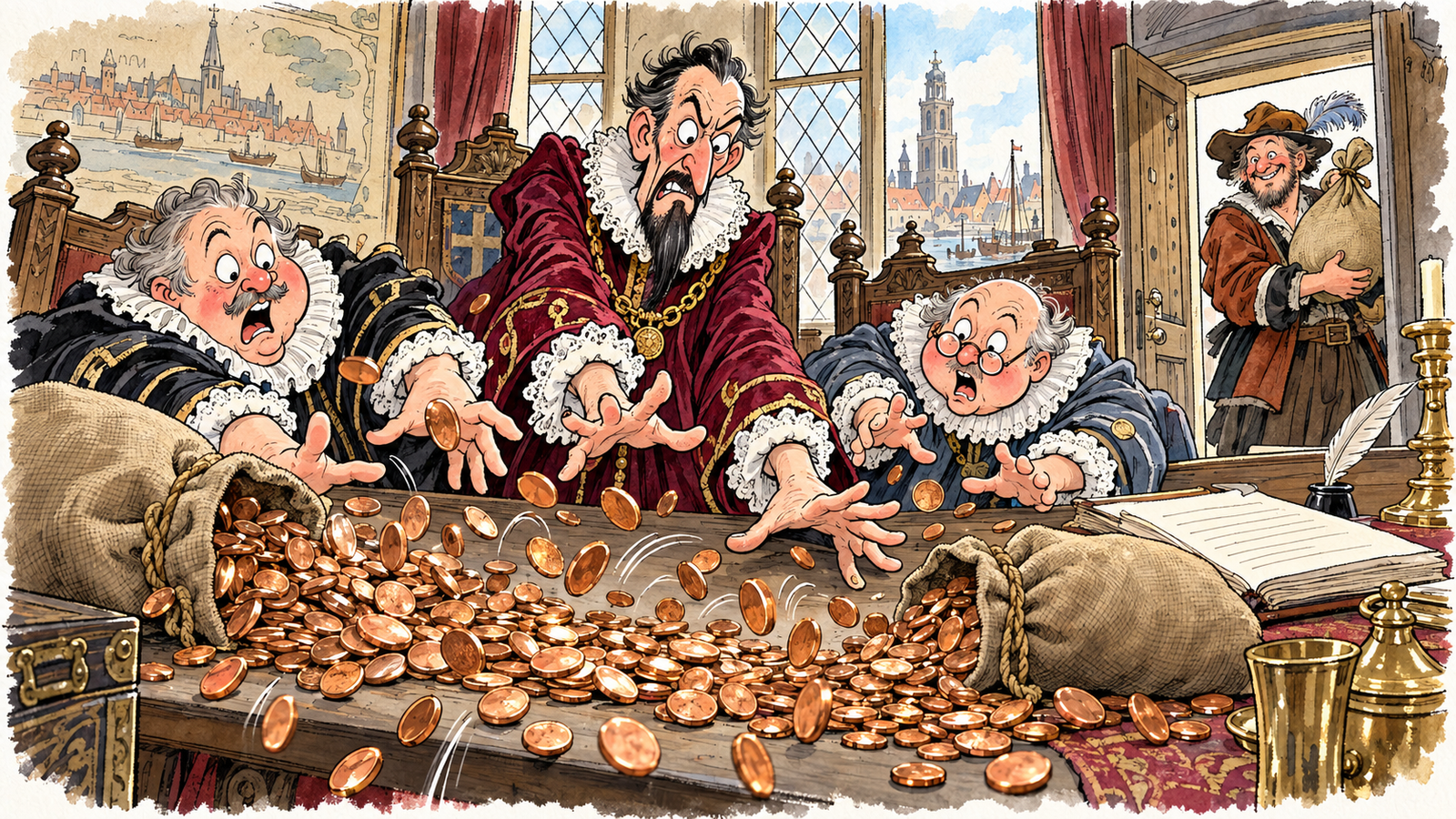
The treasurer summoned the council. He thought it good for the dignity of the town government if everyone saw how much money he had made.
The first sack was set on the table.
Small copper coins.
The second sack was opened.
More small copper coins.
“Do you have any large money as well?” asked a councillor.
“Certainly,” said the carter. “But you didn’t order that.”
The treasurer thrust out his chin.
“Money is money. We count.”
He had the doors locked. Nobody was allowed to leave until the sum was right.
The counting began in an orderly fashion. Little piles became rows. Rows became groups. Each gentleman got his own stretch of table and his own reason not to trust his neighbour.
The youngest clerk came in with bread.
“Not on the table!” the treasurer snapped at him.
The clerk stood there with the tray. Nobody had a free hand left.
A councillor sneezed.
Three little piles toppled over.
“Where was I?” he asked.
Nobody wanted to get involved.
By midday the gentlemen had hot heads. By evening they had aching backs. In the story, their fingers took on a strange blue colour from all that counting.
The treasurer held his under the lamp.
“Poor lighting.”
He had a second lamp brought in.
Now they were even bluer.
A coin rolled off the table. All the gentlemen saw it happen. They watched it bounce across the floor, tap against a chair leg and disappear underneath.
“That one’s mine,” said the treasurer.
He got down on his knees. The councillor next to him quickly made his little pile a bit taller.
The clerk saw it. So did the cat, but she was interested in the coin under the chair.
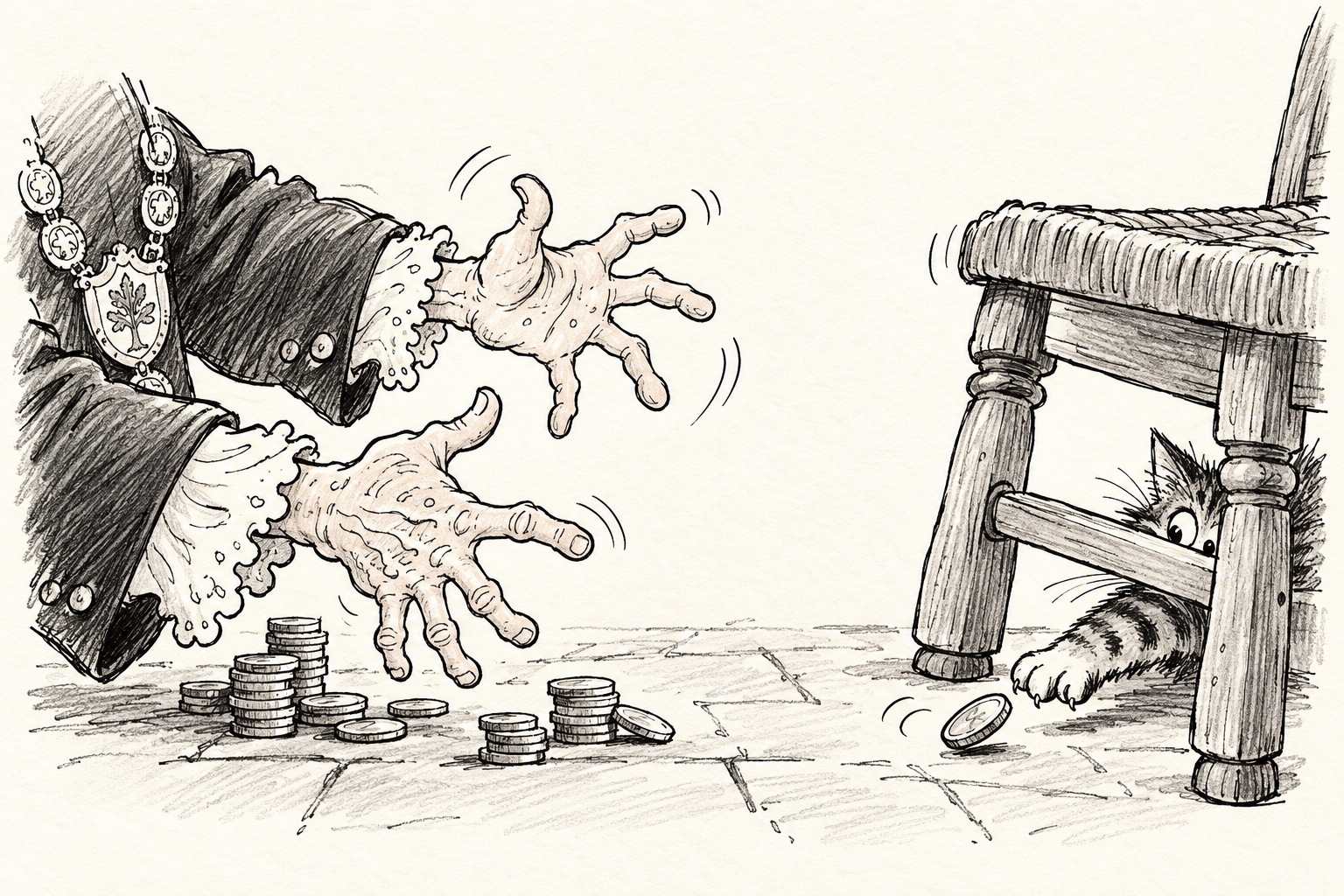
The treasurer got up, groaning, with a copper coin in his hand and dust on his forehead.
“Nobody touched anything?”
The council kept silent with conviction.
They went on counting.
Outside it grew dark. The carter had unharnessed his horse and was sitting by the door over a hot meal. Now and then he heard a number from inside. Then a curse. Then a much lower number.
The next morning he knocked.
“Done?”
The treasurer opened the door. His collar was askew. His fingers were blue as far as he could still hide them in his sleeves.
“One coin is missing.”
The carter took a coin from his pocket and laid it on the table.
Nobody moved.
“There,” he said. “That settles it.”
The treasurer examined the coin. Then he looked at his tally. A small, terrible crease appeared between his eyes.
“Or,” he said slowly, “we had already counted it.”
The carter picked up his coat.
Behind him, the clerk pulled the door shut. Very carefully. He now knew what one wrong move could cost.
And so, in this mocking tale, the people of Zwolle got their blue fingers. Whether the nickname really came about this way is another matter.
But in Kampen, or so we like to imagine, the purchased carillon rang out for the first time that evening.
The ugliest bell suddenly sounded extraordinarily cheerful.
Provenance · Freely retold
Based on the Blauwvingers (Blue Fingers) mocking tale about Zwolle and Kampen, as described by Visit Zwolle. The blue fingers are a motif from tradition, not an explanation of metal chemistry or a proven history of the name.
The dialogue and comic scenes are newly written. AI illustrations depict the tale.