Every morning, the sheriff of Weert practised his stern face in the mirror.
He drew his eyebrows together, thrust out his chin and said: “In the name of the law!”
Then he asked his wife whether his egg was ready.
He was an excellent keeper of the peace. Especially when the peace kept itself.
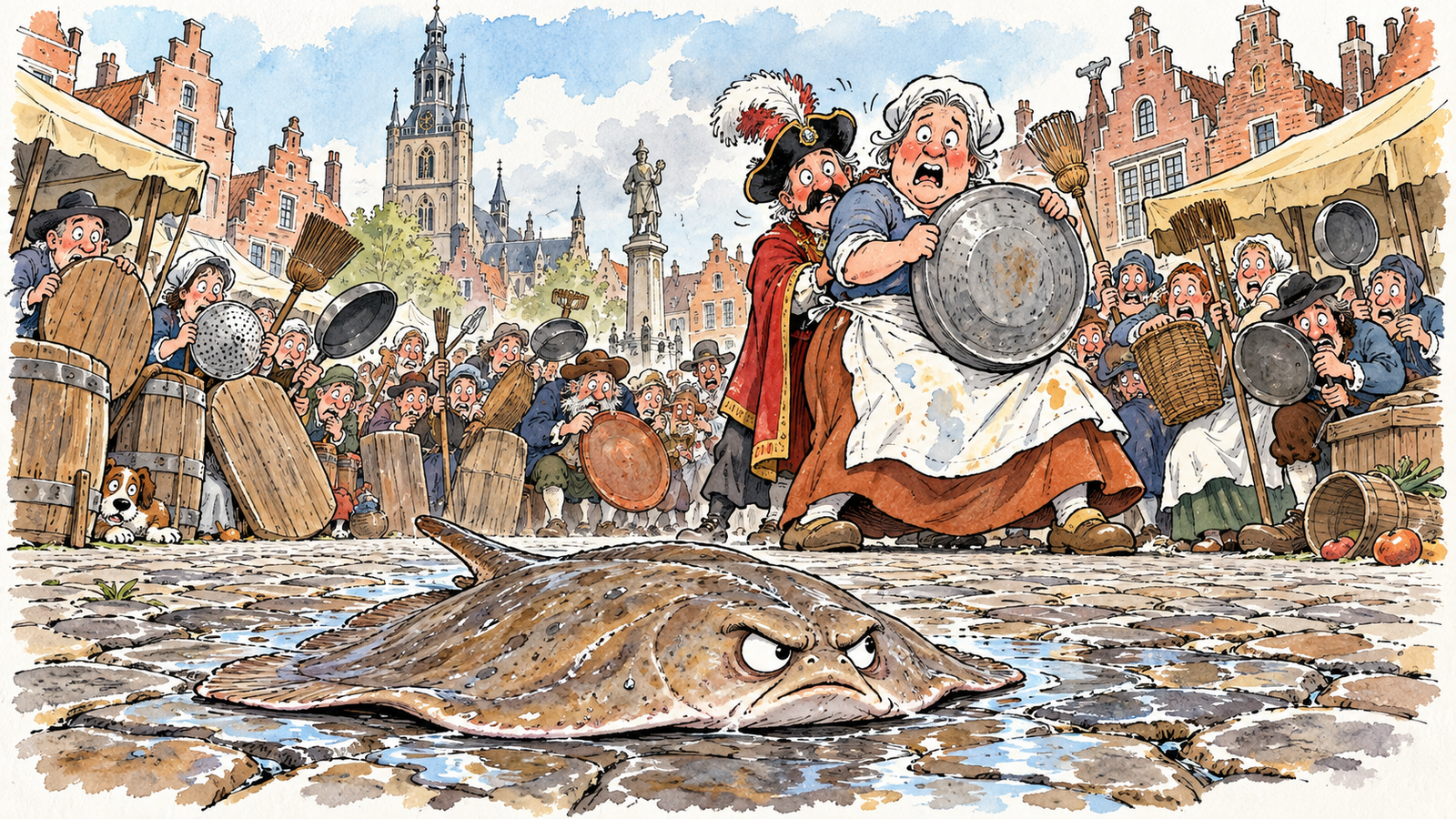
One day a fishmonger lost a ray off his cart. The fish landed in the street. It was a flat creature, with a long tail and an appearance that, out of the water, easily gives rise to misunderstandings.
A man saw it lying there.
The ray moved.
The man climbed onto a barrel.
A little later, six men were standing on three barrels.
Someone said it was a dragon. Someone else had never seen a dragon and considered that a good reason to agree.
A woman went to fetch the sheriff.
She found him at his back door.
“There’s a monster.”
The sheriff nodded. He had suspected something of the sort, because he had heard a commotion, and that was precisely why he had wanted to leave by the back.
“I’ll come at once.”
He looked for his hat.
He looked for his stick.
He looked for a different stick.
The woman took him by the arm and led him to the square.
The sheriff saw the ray. He stopped at a distance that seemed to him suitable for the exercise of his office.
“Who gave this animal permission to lie here?”
Nobody answered.
Neither did the animal.
The sheriff began a speech about courage. He explained that courage meant daring to go ahead of others.
Then he asked who would like to go first.
The blacksmith took a poker. The baker grabbed his bread peel. A man came with a scythe, but positioned himself so that his neighbour stayed between him and the enemy.
The sheriff walked behind them.
“Careful!” he called.
He did not need to say it twice.
They approached the fish step by step. When the first man stopped, the others stopped too. When the last man made a sound, they all jumped at the first.
The ray flicked its tail.
The line broke.
The baker ran into his own shop. The blacksmith climbed over a fence he had made himself and noticed for the first time that its spikes were rather sharp. The man with the scythe got caught on a washing line.
The sheriff was still standing in the same spot.
He called that holding his ground.
Reinforcements were needed. The bells were rung. Farmers from the surrounding area came with sticks, tools and faces that said someone had better have called them away from the land for something important.
The sheriff gave another speech. This time the monster had already been sighted in three villages. It had devoured livestock. Perhaps people too. He was not sure, but he had noticed that certainty was not necessary as long as you spoke gravely enough.
The farmer’s wife standing beside him looked at the fish.
“Then why is it so flat?”
The sheriff might have thought of an answer to that if the ray had not moved again at that very moment.
“Attack!” he cried.
He pulled the farmer’s wife a little way in front of him.
The crowd surged forward. Weapons were raised. There was shouting. Someone blew a horn and got only a strangled splutter out of it.
It was going to be a great day for Weert.
Then the fishmonger came back.
He pushed his way between two heroes, bent down and picked up the ray.
A silence fell that reached all the way to the town gate.
The fishmonger laid the fish on his cart.
“There you are.”
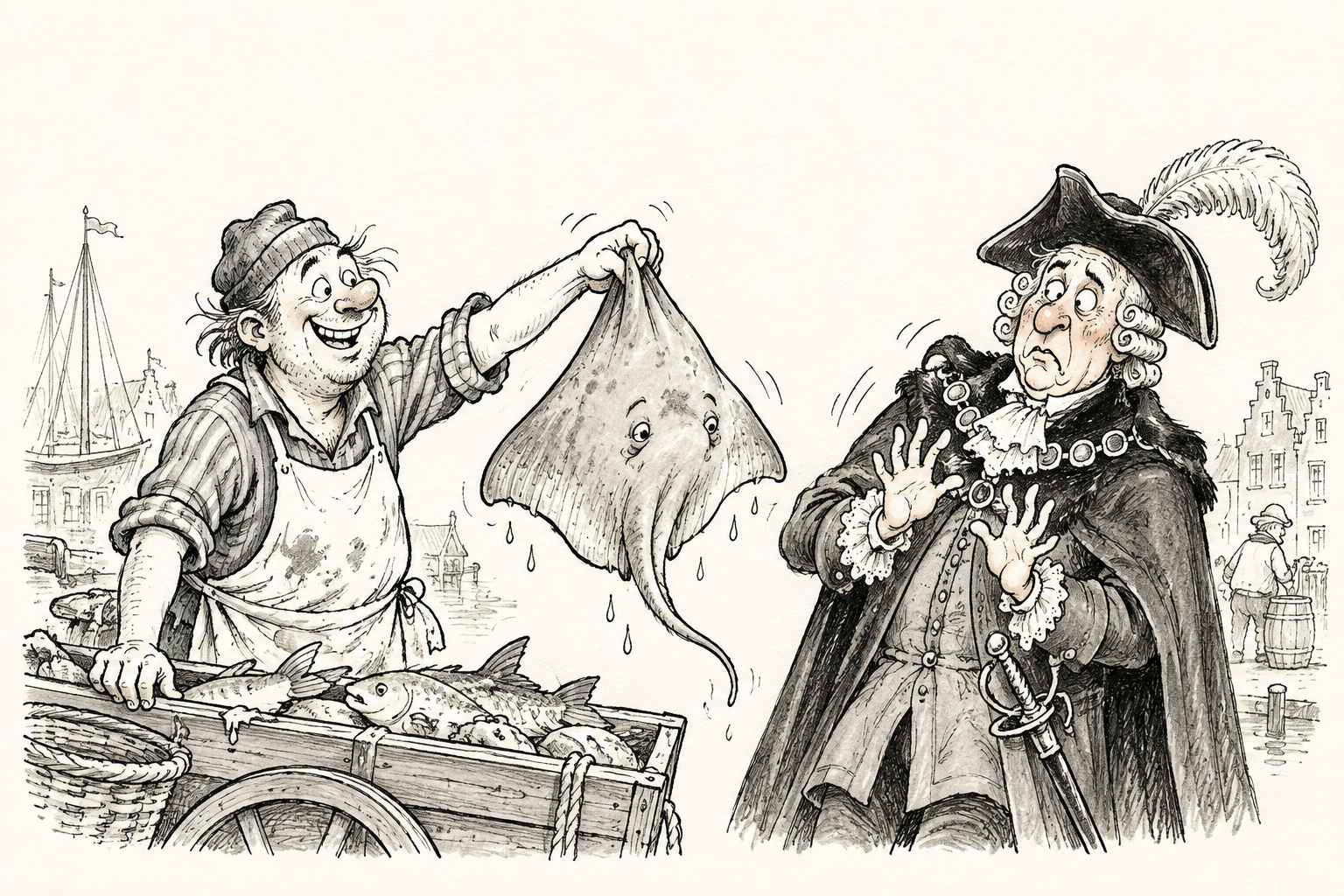
The sheriff cleared his throat.
“You know the creature?”
“I sell it.”
The fishmonger looked at the scythe, the poker and the man still standing on the barrel.
“What are you all doing?”
Nobody was doing anything any more.
One of the farmers began to laugh. He tried to hold it in, but the laugh escaped past his hand. That did not help the others.
The sheriff straightened his hat.
“We had the situation under control.”
The fishmonger pulled a rope over his load.
“Good. Then I’ll tie it down better from now on.”
He drove off.
The farmers went back to their land. On the way they told the story to anyone who wanted to hear it, and to a good many people who were busy with something else.
Ever since, in the mocking tale, the people of Weert have been called rogstekers, ray-stabbers.
The sheriff later had it recorded that the enemy had withdrawn after his intervention.
That was not a lie.
It just did not say on whose cart.
Provenance · Freely retold
Based on De Weerter Rogstekers (The Ray-Stabbers of Weert) in Josef Cohen’s Nederlandsche sagen en legenden. A lost ray is mistaken for a dangerous creature. The vain sheriff and his official report are newly worked out.
The dialogue and comic scenes are newly written. AI illustrations depict the tale.