Five Marks for a Quiet Conscience
Near Maastricht, on the Meuse in Limburg in the southeast of the Netherlands, people knew an old story about the owner of the Black Mill. It takes place during the Crusades, when preachers called on men to travel to the Holy Land for their faith. The miller Godeslas listened to one such sermon and worked out what it would cost him.
The preacher was called Oliverus. He spoke of Christ, of his suffering, and of the land around his tomb, which, he said, had to be returned to Christian rule. His voice grew soft and sorrowful, then angry, then soft again. Women wept. Men reached for their weapons.
Godeslas reached for his purse.
Not to open it. To feel that it was still there.
A cross was drawn on his tunic, his outer garment.
He was old. No one would expect him to leave in person. But money would be requested, and everyone thought he was rich. They would want a hundred marks of silver. He knew that already.
Five, he decided. Not a grain more.
Others gave what they could spare, some even their last coin. Men prepared to leave. Then the collectors came to the mill.
“Give generously, Godeslas. This is about your soul.”
“My soul?” He laid a hand on his belly, roughly where he kept his money. “Everyone keeps asking. It starts the moment a person is born and only ends when his mouth is full of earth. I once saw a tree stripped bare by caterpillars. They all came for just a bite, too.” He held his purse in both hands.
“Try my neighbour. He has money.”
“And you do not?”
“Do you know what I own? Have you weighed it? You can look down a well to see how deep the water is. But you have no business looking in my purse.”
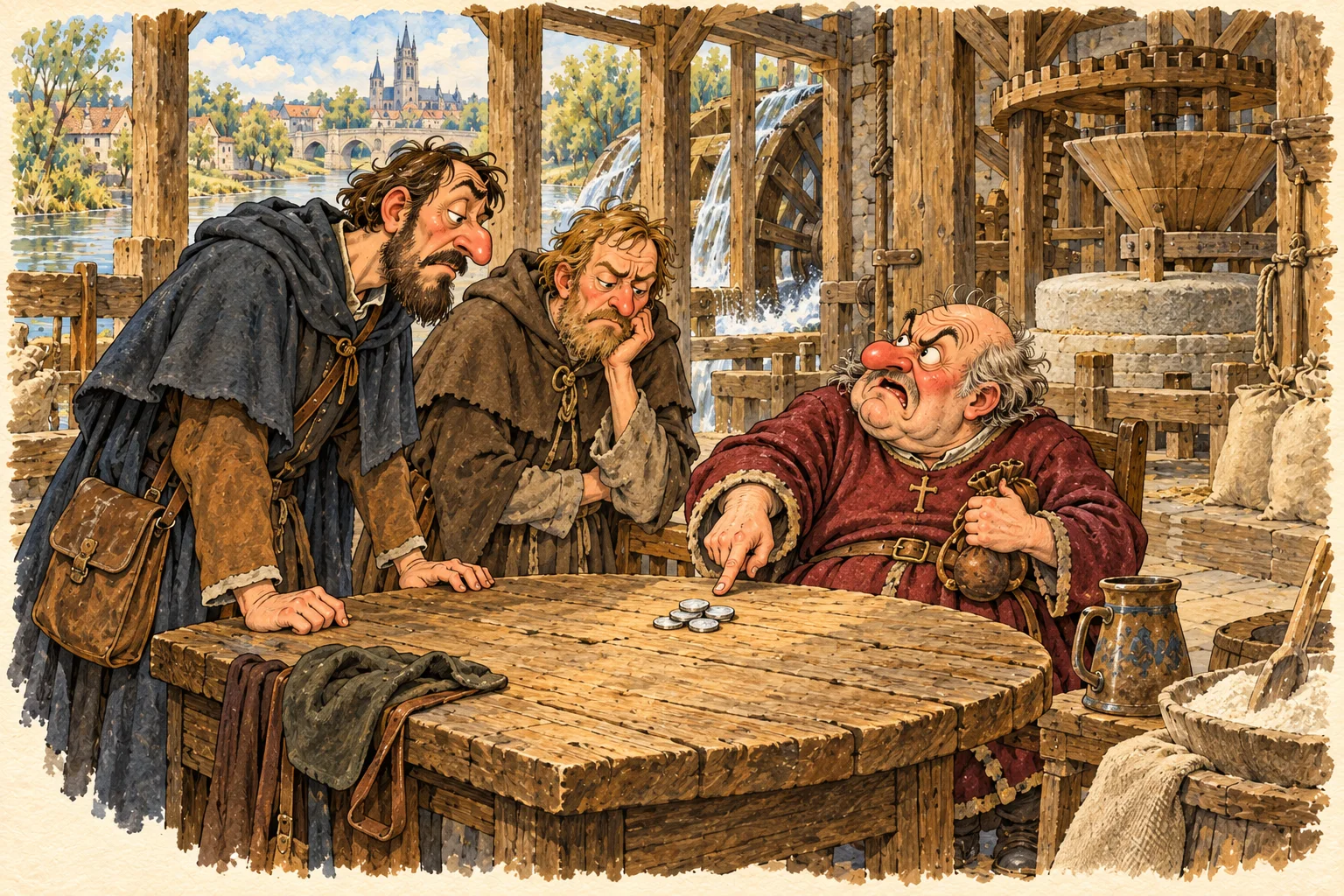
Still, he would give something. He did not want people to call him miserly, after all. He tossed five silver marks onto the table.
The collectors looked at the money.
“A hundred would not hurt you.”
“There it is!” Godeslas pointed at them as if he had just caught a mouse in his flour. “A hundred! I give from my poverty and you start talking about a hundred!”
They took the five marks away. They did not thank him.
When they had gone, he laughed. He had done his part and would remain safe at home.
Later, Crusaders passed the mill. Godeslas called after them, asking how many of them would return. They kept walking.
“Five marks!” he shouted. “That’s all it cost me! I’ll stay in my own bed for that!”
He was still chuckling about it that evening.
Summer came. The stream ran so low that it no longer drove the mill. The wheels fell silent.

Until one night Godeslas woke to the sound of grinding.
He listened. A dream, he thought. Or the wind.
Then his bed began to rumble too.
The mill really was grinding. His mill. In the middle of the night, without his permission.
He roared for his servant and sent him to look.
Now he could hear water rushing too. The dry stream sounded as if a whole mountain of snow had melted at once. Godeslas sat upright, hands against his head. He waited for the servant to return.
The footsteps approached slowly.
“What is happening out there?”
The servant stretched out his arms. Not a word came.
Godeslas asked again. The man remained silent. Behind him, the mill rattled on.
The miller dressed and went himself. Inside, a dark figure waited. It beckoned him closer, toward the heavy millstones.
Silver was being ground between them. A ghastly crowd was shoving it underneath. Five marks. His five marks, with which he had thought to get off so cheaply.
The dark man had brought two horses.
“We’re going for a ride.”
Godeslas looked at the stones. The silver was disappearing between them.
“Take off your tunic first.”
The cross on his tunic kept the devil at a distance. Godeslas could have left it on. But the man who had haggled over every coin now took off his tunic without a word.
As soon as the garment was off, the dark man seized him. He lifted him as if he weighed nothing and threw him onto a horse. They rode into the night, farther and farther from the mill.
The grinding stopped.
Only soft water could be heard in the stream.