Zaanse Schans: windmills, museums and a village of moved houses
The Zaanse Schans was built in the twentieth century from buildings that once stood elsewhere in the Zaan region. What you see points back to a region where more than six hundred windmills turned in the eighteenth and nineteenth centuries.
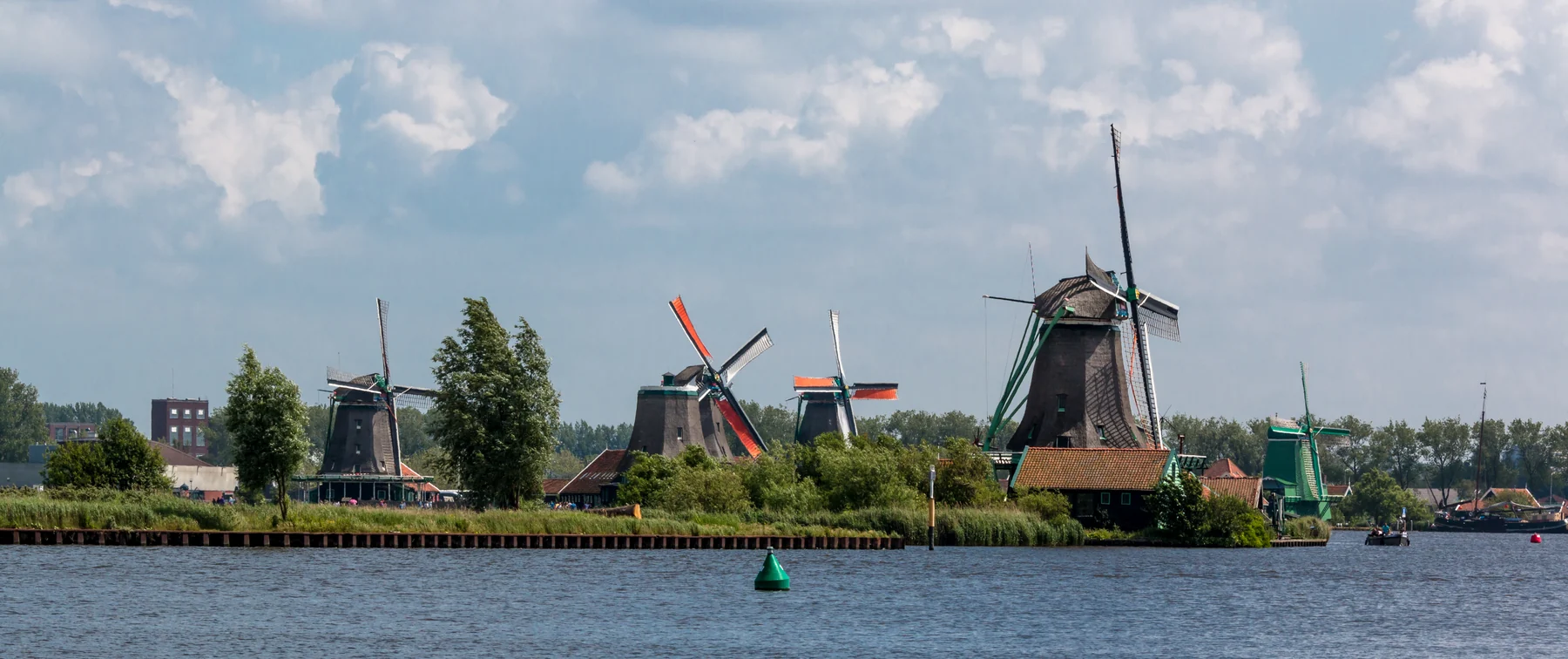
The Zaanse Schans is freely accessible: you walk into the village without passing a gate. People also live and work there. Between the green wooden houses stand windmills, workshops and shops, and the museums lie by the water.
The village was laid out on purpose. Architect Jaap Schipper presented the plan in 1946 and is regarded as the spiritual father of the Zaanse Schans. From 1961, existing buildings from the Zaan region were brought to the site by road and by water and restored. Until 1963 the Stichting Zaans Schoon led the preparation, the design and the first relocations, under the supervision of Schipper and with the support of the Zaandam municipal architect G.M.G. Bakker. In 1963 a second restoration architect arrived: Cornelis de Jong, who was the first to rebuild the house from the Zeilenmakersstraat in Westzaan.
The aim was to let people experience Zaan heritage up close rather than only read about it in history books. The Schans shows how a Zaan residential and working neighbourhood looked around the middle of the nineteenth century, with houses, warehouses, windmills, ditches and land.
There is a reason for the windmills. In the eighteenth and nineteenth centuries the Zaan region was an industrial area with more than six hundred windmills at the same time. They produced sawn timber, paper, ground spices, edible and paint oils, dyes, fibres, flour and cocoa powder. Industrial sawing became possible thanks to the crankshaft that Cornelis Corneliszoon van Uitgeest invented in 1594: it turns the rotating motion of a mill into a sawing motion. In the seventeenth century 26 shipyards in the region launched some one hundred to one hundred and fifty ships a year.
Twelve mills stand on the Schans. De Kat is a paint mill that makes pigments, chalk and oil. De Zoeker is an oil mill. Het Jonge Schaap is a hexagonal sawmill, built as a replica in 2007. De Huisman is a spice mill that began in 1786 as a snuff mill, and De Bleeke Dood is a stone grist mill, a stellingmolen that once ground flour for the local bakers.
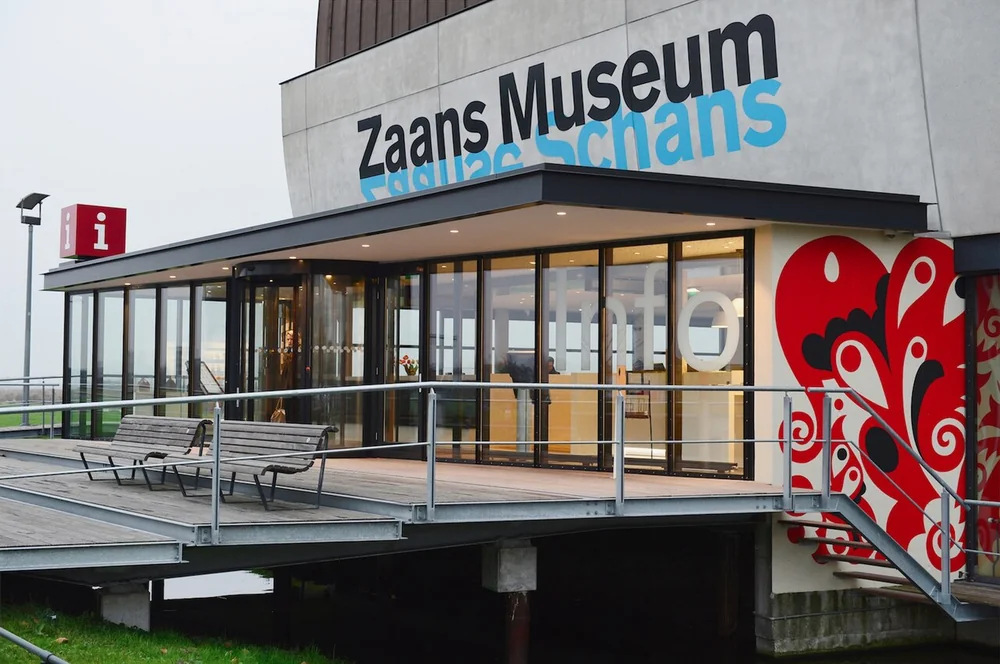
The museums also show what was made in the region. The Zaans Museum, opened in 1998 at Schansend 7, presents together with the Verkade Experience a factory as it looked in the early twentieth century, with working machines and the history of chocolate and biscuits. The Museumwinkel Albert Heijn at Kalverringdijk 5 holds the original interior of a small grocery shop; Albert Heijn took over his parents' shop in 1887, at the age of 21. The building is a national monument. The Bakkerijmuseum at Zeilenmakerspad 4 is housed in a bakery from 1658 with an authentic bread oven, where you can taste the duivekater. The building stood on the Hazepad in Zaandijk until 1970.
Zaandijk–Zaanse Schans station is about a fifteen-minute walk from the village, and from Amsterdam Centraal it is some 17 minutes by stopping train. Bus line 800 takes about 24 minutes, and line 801 stops right next to the Zaans Museum. Cycling is not allowed on the narrow paths between the houses.
Practical
Address: Zaanse Schans, navigation address Schansend 7, Zaandam
Train: Zaandijk–Zaanse Schans station, about 15 minutes on foot; about 17 minutes by stopping train from Amsterdam Centraal
Bus: line 800 from Amsterdam Centraal in about 24 minutes; line 801 stops next to the Zaans Museum
Parking: 15 euros per visit for cars
Cycling is not allowed on the narrow paths between the houses